What the maker puts in writing
- Title: “2.1 Channel Soundbar with Wireless Subwoofer - Bluetooth, HDMI ARC, Roku TV Ready, 40W Max Power, Black”
- Bullet 1: “This 140W soundbar system will make everything louder, clearer and deeper. 2.1 channels bring out the best in effects, score, and dialogue. The wireless subwoofer lets you feel the bass”
- Description: “a powerful soundbar with wireless subwoofer with total output of 140W”
- “Roku TV Ready means you’ll enjoy a smoother setup, easy access to sound settings, and compatibility with your Roku remote”
- “This compact soundbar is perfect for small spaces… Wall brackets are integrated for easy mounting”
- “Included in the box: Power cord, 2 x AAA Batteries, remote control, wall mount bracket, quick start guide, warranty card”
The title and the bullet disagree by a factor of three and a half
Title: 40 W max. Bullet 1: 140 W. Description: 140 W total output.
Two against one, and the shape of the error is plain: a leading 1 fell out of the title.
The 140 W figure is also the one that fits. A hundred and forty watts split across a bar and a powered subwoofer is an ordinary rating for a 2.1 system — where 40 W would put it below Philips’s own 2.0 bars at 60 W, which makes no sense for a product with an extra powered cabinet.
Read it as 140 W. And read that as a maximum, like nine of the twelve figures on this shelf.
Fifty-six cents is the best decision on this shelf
Philips sells two bars within a dollar of each other:
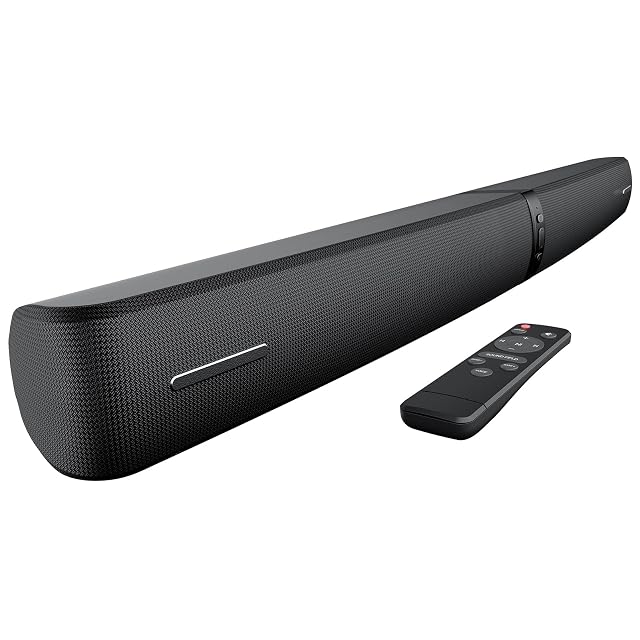
B4208 — $117.38 — 2.0 channel, no subwoofer, metal grille, slanted body
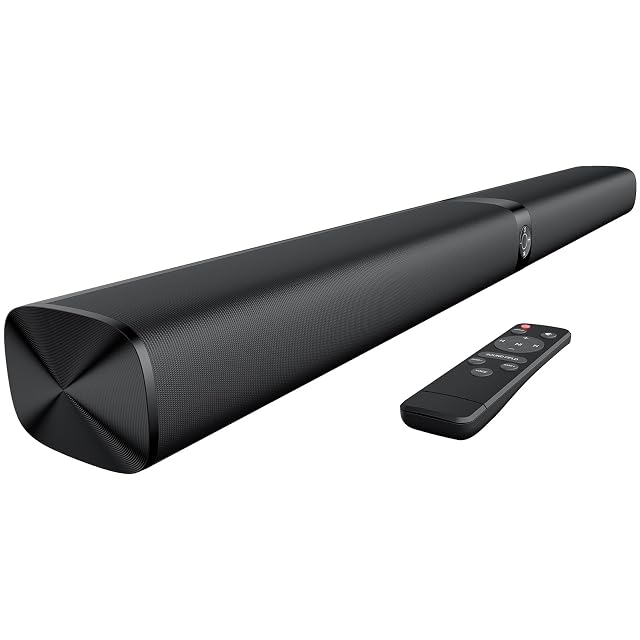
B5306 — $117.94 — 2.1 channel with a wireless subwoofer, trapezoid body
Fifty-six cents apart, and the physics decides it.
Reproducing a 50 Hz note means moving a lot of air. A bar 67 mm (2.64 in) deep has neither the cone area nor the internal volume for it, so everything below roughly 100 Hz is absent: the explosions, the bass lines, the weight under a voice. A separate cabinet does nothing but that, which is why it does it well.
Buy the bass.
And wireless matters on top of that
Bass wavelengths are meters long, so they interact with the dimensions of the room to create standing waves — places where bass piles up and places where it nearly disappears. Move a subwoofer three feet and it changes character entirely.
A wireless subwoofer can therefore go where the bass is even, rather than where the cable reaches.
Two bars here are wireless — this and the Hisense at $119.99. Suntrok at $81.21 is wired, stated twice in its own listing.
What you give up against the B5109
B5109 — $77.99 — 2.0 · 120 W · Dolby Digital Plus · DTS Virtual:X · 4 EQ modes · Night Mode · app · BT 5.4
B5306 — $117.94 — 2.1 + wireless subwoofer · 140 W · no Dolby or DTS named · no EQ modes stated
So forty dollars buys the subwoofer and costs you the decoding.
If you watch films and want weight: the subwoofer. Bass is the most audible change a soundbar can make.
If you watch broadcast television or streaming with real surround mixes: Dolby Digital Plus, because decoding it means receiving the actual mix rather than a stereo downmix.
What is not published
No weight, where the B5109 gives 1,928 g and the B4000 2,200 g.
No driver count and no driver size — none of the four Philips bars publishes either, where Suntrok gives diameters and Bose names two full-range drivers plus a center tweeter.
No HDMI cable in the box. The listed contents are a power cord, batteries, remote, wall mount bracket and papers — so the recommended HDMI ARC connection needs a cable you supply. Amazon, Hisense, Majority and Suntrok all include one.
962 × 376 × 217 mm is published for the system, bar plus subwoofer.
Availability
At the check, the American Amazon store stood at roughly $120.
These numbers are what Keepa carried on the day this page was last built. Stock and prices move without notice.
Prices quoted in this text were read on 4 October 2026. The live price is at the top of the page.
What gets asked most
Is it 40 watts or 140?
The listing says both, and the two differ by a factor of three and a half. The title reads "2.1 Channel Soundbar with Wireless Subwoofer - Bluetooth, HDMI ARC, Roku TV Ready, 40W Max Power, Black". The first bullet reads "This 140W soundbar system will make everything louder, clearer and deeper." And the description agrees with the bullet: "total output of 140W". Two sources against one, and the shape of the error is obvious — a leading "1" dropped out of the title. The 140 W figure is also the one that fits the product: 140 W across a bar and a powered subwoofer is an ordinary rating for a 2.1 system, where 40 W would be below the maker’s own 2.0 bars at 60 W. Treat 140 W as the intended figure, and remember it is a maximum, not an RMS rating.
Is the wireless subwoofer worth fifty-six cents?
It is the best value decision on this shelf, and it is not close. Philips sells the B4208 at $117.38 — 2.0 channel, no subwoofer — and this B5306 at $117.94 — 2.1 channel with a wireless subwoofer. Fifty-six cents apart. The physics makes the choice: reproducing a 50 Hz note means moving a large volume of air, and a bar 67 mm (2.64 in) deep has neither the cone area nor the enclosure volume to do it. Everything below roughly 100 Hz — explosions, bass lines, the weight under a voice — is simply absent from a 2.0 bar. A separate cabinet does nothing else, which is why it does it well. And wireless matters on top of that: bass wavelengths are meters long and interact with the room, so a subwoofer you can place freely can be positioned where the bass is even rather than where the cable reaches.
What do I give up against the B5109?
Both surround formats and some power, for a subwoofer — and which way that trades depends on your room. The B5109 at $77.99: 2.0, 120 W max, Dolby Digital Plus, DTS Virtual:X, four EQ modes, Night Mode, Philips app, Bluetooth 5.4 with LE Audio — no subwoofer. This B5306 at $117.94: 2.1 with a wireless subwoofer, 140 W, no Dolby or DTS named, no EQ modes stated. So forty dollars buys the subwoofer and costs you the decoding. If most of your watching is films and you want weight, the subwoofer wins — bass is the most audible difference any soundbar can make. If you watch a lot of broadcast television or streaming with proper surround mixes, decoding Dolby Digital Plus means receiving the real mix rather than a stereo downmix.