Skip to content

Assistrust KY-8000 review

A detachable 80 W soundbar with four drivers and three equaliser modes, for under fifty dollars.

The closing call Fifty dollars, four drivers and a body that splits into two speakers — which is the real feature, and the bullets bury it under four placements that are actually three.

What the maker puts in writing

  • “Elevate faint sounds to vibrant with automatic loudness boost. Experience immersive sound through 4 versatile placements—horizontal for distortion-free audio, vertical for room-filling sound, tabletop for vibrant clarity, or wall mount for 360° cinematic magic”
  • “Powered by 4 high-performance drivers, 80W powerful sound output”
  • “Fine-tune your listening experience with 3 dynamic equalizer modes—movie, music, and news”
  • “Enjoy seamless setup with cutting-edge Bluetooth 5.0 or reliable ARC, OPT, and AUX connections”
  • “Enjoy peace of mind with our 18-month warranty and 24/7 online tech support. Our 60-day hassle-free replacement policy”
  • Title: “2 in 1 Detachable Soundbar for TV/PC/Gaming/Projectors”

The feature worth buying is in the title, not the bullets

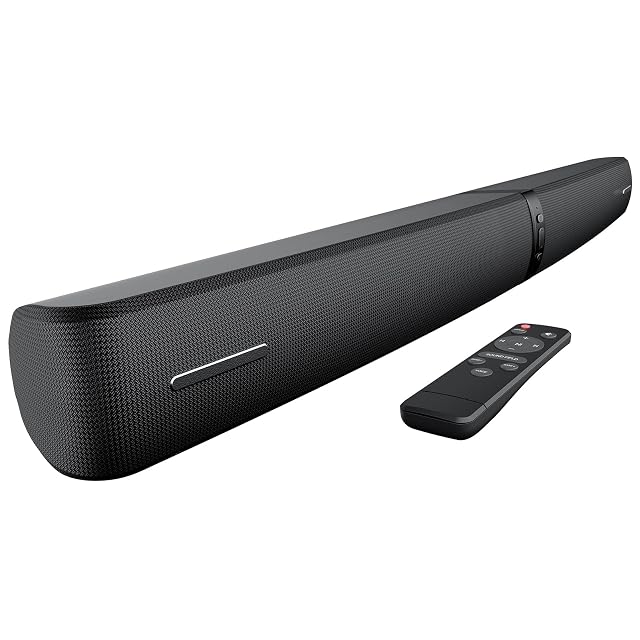
2 in 1 detachable. The bar separates into two speakers.

That is the only product on this shelf that does it, and it changes what fifty dollars buys: not just a bar under the television, but a pair of speakers you can space apart for a desk or a PC.

A soundbar’s fundamental limitation is that its left and right drivers sit inches from each other, so the stereo image is narrow however the processing is dressed up. Separating them fixes that physically.

None of the five bullets leads on it.

Four placements, three positions

Horizontal for distortion-free audio, vertical for room-filling sound, tabletop for vibrant clarity, or wall mount.

Horizontal and tabletop are the same position. Nothing in the listing distinguishes them.

Its stablemate on this shelf, the KY2023, does it more plainly: four placements of which “Wall Mount” appears twice, with two different sound descriptions and no word on which two orientations are meant.

And 360° from a wall is not a thing

Wall mount for 360° cinematic magic.

A bar flat against a wall radiates forward. The wall is behind it, and sound does not pass through a wall.

What a bar genuinely can do is bounce sound off the side walls to widen the front image — JBL calls it MultiBeam, Sony calls it S-Force Pro. The result is a wider stage, not sound from behind you.

Sony’s S100F on this same shelf states it correctly: S-Force Pro Front Surround.

Eighty watts, and the trap on this shelf

Ten of the twelve bars here publish a maximum or peak figure. This is one of them.

Only the Majority Sierra publishes RMS — 120 W continuous — which is the only figure on the shelf that means something measurable.

So 120 W RMS beats a “240 W peak” bar, even though the bigger number reads twice as good. Treat every “max” here as a size class, not a measurement.

And the inversion worth noticing: Sony, Amazon and Bose publish no wattage at all. The brands you have not heard of publish 240.

What fifty dollars does not include

No subwoofer. Everything below roughly 100 Hz is beyond a cabinet 64 mm deep. Hisense at $119.99 includes a wireless one; Suntrok at $81.21 includes a wired one.

No Dolby, no DTS. Philips’s B5109 at $77.99 has both Dolby Digital Plus and DTS Virtual:X.

Bluetooth 5.0, the oldest version on this shelf, against 5.3 and 5.4 elsewhere.

No HDMI cable stated, where Amazon and Hisense both include one — and where Bose at $279 explicitly sells it separately.

Availability

At the check, the American Amazon store stood at roughly $50.

These numbers are what Keepa carried on the day this page was last built. Stock and prices move without notice.

Prices quoted in this text were read on 4 October 2026. The live price is at the top of the page.
In its favor, and against it

Strengths

  • It splits into two separate speakers, which no other bar on this shelf does
  • Four drivers and three equaliser modes for under fifty dollars
  • An eighteen-month warranty with a sixty-day replacement policy, which only its stablemate matches

Compromises

  • Counts four placements and describes three, with "horizontal" and "tabletop" meaning the same thing
  • Claims 360° sound from a wall-mounted bar, which the geometry will not do
  • No subwoofer, no named surround format, and Bluetooth 5.0 against 5.3 and 5.4 elsewhere here

Specifications

Body2 in 1 DETACHABLE — it splits into two separate speakers
Drivers4, stated high-performance
Power80 W — a maximum, not an RMS figure
Equaliser3 modes: movie, music, news
LoudnessAutomatic boost, stated to lift faint sounds
ConnectionsBluetooth 5.0, ARC, optical and AUX
Placements claimed4 — horizontal, vertical, tabletop, wall; see the FAQ
Warranty18 months, with 24/7 support and a 60-day replacement policy
Weight2971 g (104.8 oz)
Dimensions432 × 89 × 64 mm (17 × 3.50 × 2.52 in)
SubwooferNone
Surround formatsNone named — no Dolby, no DTS
HDMI cableNot stated, where Amazon and Hisense include one
Bluetooth version5.0 — the oldest on this shelf
Amazon referenceB0DNZCJ93D
EAN6977741970289

What gets asked most

Are there really four placements?

Three, described as four — and the same slip appears on its stablemate. This listing gives "4 versatile placements—horizontal for distortion-free audio, vertical for room-filling sound, tabletop for vibrant clarity, or wall mount for 360° cinematic magic". But a soundbar lying horizontal on a surface and a soundbar on a tabletop are the same position stated twice; there is nothing to distinguish them. The Assistrust KY2023 on this shelf does it more plainly still: its four are "Standing Tabletop... Wall Mount... Flat Tabletop... Wall Mount", listing wall mounting twice with two different sound descriptions and never saying which two orientations it means. What is genuinely interesting is the feature the bullets bury: this is a "2 in 1 detachable" bar that separates into two speakers.

Can a wall-mounted soundbar give 360° sound?

No, and the geometry is not arguable. "Wall mount for 360° cinematic magic" describes sound arriving from every direction around the listener. A soundbar flat against a wall radiates forward into the room; the wall is behind it, and nothing passes through a wall. At best a bar can bounce sound off the side walls to widen the stage — a real technique, which JBL calls MultiBeam and Sony calls S-Force Pro, and which produces a wider front image rather than sound from behind you. For actual surround you need speakers physically behind the listener, or at minimum a processed effect the maker describes honestly. Sony’s S100F on this shelf puts it correctly: "S-Force Pro Front Surround".

Is 80 watts comparable to the 240 watts elsewhere on this shelf?

Not directly, and this is the one number to be careful with on the whole shelf. Ten of the twelve bars here publish a maximum or peak figure — a momentary ceiling the amplifier can touch, not a level it sustains. This bar’s 80 W is one of those. Only the Majority Sierra publishes an RMS figure: "120W RMS", which is a continuous rating and therefore the only number here that means a measurable thing. The practical consequence is counter-intuitive: 120 W RMS is a more powerful bar than a "240 W peak" one, even though the larger number looks twice as good. And the three best-known brands on this shelf — Sony, Amazon and Bose — publish no wattage at all.

Against the home cinema devices in the same bracket

Between home cinema devices of the same category and nearby price. Shown: what they all state. A half-filled column says nothing.

Model Price PowerWeightDimensions
Assistrust KY-8000 $50 80 W — a maximum, not an RMS figure2971 g (104.8 oz)432 × 89 × 64 mm (17 × 3.50 × 2.52 in)
Assistrust KY2023 $60 90 W — a maximum, not an RMS figureNot published787 × 51 × 102 mm (31 × 2.01 × 4.02 in)
Philips B4000 (TAB4000/37) $75 60 W maximum2200 g (77.6 oz)104 × 762 × 65 mm (4.09 × 30 × 2.56 in)
Philips B5109 (TAB5109/37) $78 120 W maximum — double the maker’s two 60 W bars1928 g (68 oz)91 × 766 × 67 mm (3.58 × 30.2 × 2.64 in)

What the models do not share, in home cinema devices

  • If price decides: this model, at $50.
  • Highest Power in the table: Philips B5109 (TAB5109/37) (120 W maximum — double the maker’s two 60 W bars).
  • Highest Dimensions in the table: Assistrust KY2023 (787 × 51 × 102 mm (31 × 2.01 × 4.02 in)).

Who should pick this one, among home cinema devices

Two small speakers and a soundbar in one box, for fifty dollars

What buyers actually choose

Amazon reports what buyers took in the month before this page was last checked: at least 10,000.

The figure is a floor, rounded by Amazon, and read through Keepa — it says what buyers picked, not what a maker claims.

Sources

Specifications: the manufacturer sheet for home cinema gear and the matching Amazon product page. Prices and availability: Keepa. Every figure on this page names its source.

The method applied to these home cinema devices