What the maker puts in writing
- “For a soundbar that produces clear sound through 2.0 channels… Volume up without distortion, so you can amp up the drama without missing the dialogue”
- “Easy connectivity with Bluetooth 5.4 enables better sound synchronization, for smooth audio streaming with reduced lag”
- “With versatile HDMI-ARC connectivity, sync up to other devices seamlessly without the clutter of multiple cables”
- “Offering the reliability of European products” and “Built with EU expertise for reliable quality”
- “This product is Roku TV Ready-supported in the United States, Canada, Mexico, the United Kingdom, and Brazil”
- “2.0 channels, 60W max”
Three dollars decides this
Philips sells four bars on this shelf, and two of them sit within three dollars of each other:
B4000 — $75.10 — 2.0 · 60 W max · Bluetooth 5.4 · HDMI ARC · Roku TV Ready
B5109 — $77.99 — 2.0 · 120 W max · Bluetooth 5.4 · HDMI ARC · Roku TV Ready · Dolby Digital Plus · DTS Virtual:X · four EQ modes · Night Mode · Philips app · optical and USB in
Two dollars and eighty-nine cents buys double the stated power and both surround formats.
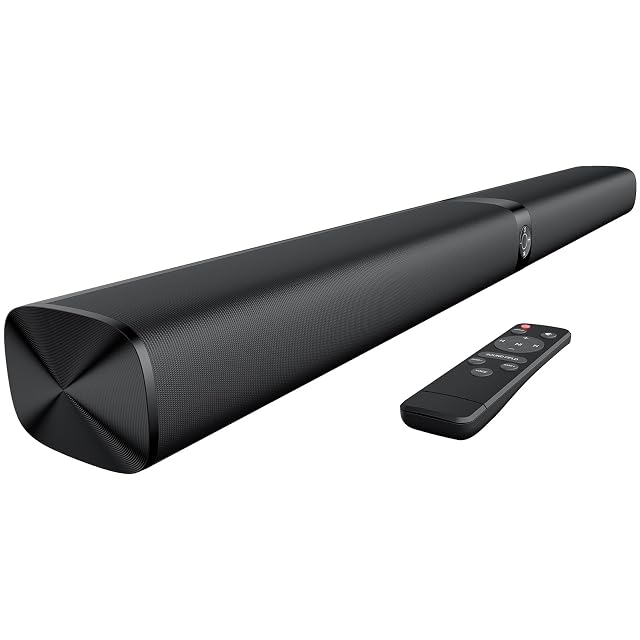
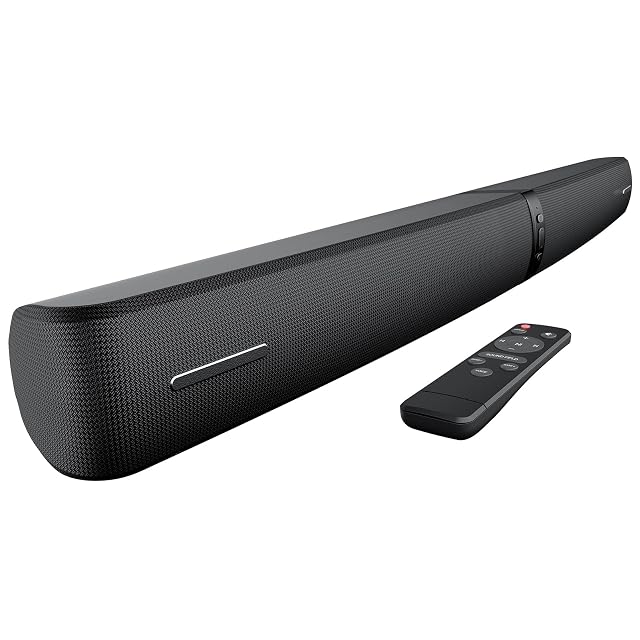
Nothing in the audio specification favors this one. If the shape suits your shelf better, that is the argument; there is no other.
And the full Philips ladder is worth seeing, because it inverts
B4000 — $75.10 — 2.0 · 60 W · BT 5.4
B5109 — $77.99 — 2.0 · 120 W · Dolby + DTS · BT 5.4
B4208 — $117.38 — 2.0 · 60 W · no Dolby, no DTS · BT 5.3
B5306 — $117.94 — 2.1 + wireless subwoofer · 140 W
The B5109 at $77.99 strictly beats the B4208 at $117.38 — double the power, both formats, newer Bluetooth, thirty-nine dollars cheaper. The B4208’s only distinguishing claim is a slanted “geometric design” with a metal grille.
Bluetooth 5.4, in proportion
Better sound synchronization… reduced lag.
Latency is the gap between your phone sending a sound and the speaker producing it, and on older Bluetooth it can get wide enough that lips and dialogue visibly separate. Newer versions narrow it and hold the link better at range.
The versions on this shelf: 5.4 here and on the B5109 · 5.3 on the B4208, the KY2023 and the Hisense · 5.0 on the Assistrust KY-8000 and the Majority Sierra.
Keep it in proportion, though: for television you will use HDMI ARC, which has no such problem.
Sixty watts, and the shelf-wide trap
Ten of the twelve bars here publish a maximum. This is one of them.
Only the Majority Sierra publishes RMS — 120 W continuous, the single comparable figure on the shelf. So 120 W RMS beats a “240 W peak” bar despite reading half as large.
And Sony, Amazon and Bose publish no wattage at all.
What is not published
No equaliser modes, where the B5109, the B4208 and the B5306 all have four (Movie, Music, Voice, Stadium) and the Hisense has six.
No driver count and no driver size. None of the four Philips bars publishes either; Suntrok gives actual diameters, Bose names two full-range drivers and a center tweeter, Sony a tweeter.
No subwoofer, and no HDMI cable stated in the box — where Amazon, Hisense, Majority and Suntrok all include one.
2,200 g and 104 × 762 × 65 mm are published.
Availability
At the check, the American Amazon store stood at roughly $75.
These numbers are what Keepa carried on the day this page was last built. Stock and prices move without notice.
Prices quoted in this text were read on 4 October 2026. The live price is at the top of the page.
What gets asked most
Why would I buy this rather than the B5109?
On the published specification, you would not — and the gap is two dollars and eighty-nine cents. This B4000 at $75.10: 2.0 channel, 60 W max, Bluetooth 5.4, HDMI ARC, Roku TV Ready. The B5109 at $77.99: 2.0 channel, 120 W max, Bluetooth 5.4, HDMI ARC, Roku TV Ready — plus Dolby Digital Plus, plus DTS Virtual:X, plus four EQ modes (Movie, Music, Voice, Stadium), plus a Night Mode, plus a Philips app, plus optical and USB inputs. So for $2.89 the dearer bar doubles the stated power and adds both surround formats and app control. The only argument for this one is if the B4000’s shape or finish suits a specific shelf better; nothing in the audio specification favors it.
What does Bluetooth 5.4 actually improve?
Synchronization, mainly, which is the thing you notice. Philips states it directly: "Bluetooth 5.4 enables better sound synchronization, for smooth audio streaming with reduced lag." Latency is the gap between a sound being sent by your phone and arriving at the speaker, and on older Bluetooth it can run high enough that lip movement and dialogue visibly separate. Newer versions reduce it and hold the connection more reliably at range. On this shelf the versions run: 5.4 here and on the B5109, 5.3 on the B4208, the KY2023 and the Hisense, and 5.0 on the Assistrust KY-8000 and the Majority Sierra. Worth keeping in proportion, though: for watching television you will use HDMI ARC, not Bluetooth, and ARC has no such latency problem.
Is Roku TV Ready worth anything over plain HDMI ARC?
A convenience layer, and it is smaller than the badge implies. HDMI ARC already gives you one-remote volume control on any television — that is what ARC is for, and every bar on this shelf has it. What Roku TV Ready adds is that the soundbar’s own settings appear inside the Roku TV menu, so you adjust bass, treble and modes from the television’s interface rather than hunting for the bar’s remote. This listing is also the only certification on the shelf to publish its geographic limits: "Roku TV Ready-supported in the United States, Canada, Mexico, the United Kingdom, and Brazil". Amazon’s bar carries the equivalent Fire TV Ready badge for its own ecosystem. On a television of any other brand, both reduce to ordinary ARC.