What the maker puts in writing
- “This 2.0-channel, 120W soundbar boosts audio for movies and shows, delivering louder, clearer, and richer sound. Adjust treble and bass via remote”
- “With DTS Virtual, you can enjoy immersive 3D audio, and don’t need extra speakers! Activate it via remote or PHILIPS app. Plus, Dolby Digital Plus adds depth”
- “Use the PHILIPS app or remote to select from four EQ modes (Movie, Music, Voice, Stadium)… Night Mode is designed for nighttime viewing”
- “Pair with your smartphone via Bluetooth 5.4. Connect music sources using Aux-in or USB, or enjoy immersive sound through optical input or HDMI ARC”
- “Bluetooth 5.4 with LE Audio” and “fully compatible with any Roku TV remote”
It beats the Philips thirty-nine dollars above it, on every line
B5109 — $77.99 — 120 W max · Dolby Digital Plus · DTS Virtual:X · 4 EQ modes · Night Mode · app · ARC + optical + AUX + USB · Bluetooth 5.4
B4208 — $117.38 — 60 W max · no Dolby · no DTS · ARC + optical + AUX + USB · Bluetooth 5.3
Half the power, neither surround format, older Bluetooth — for $39.39 more.
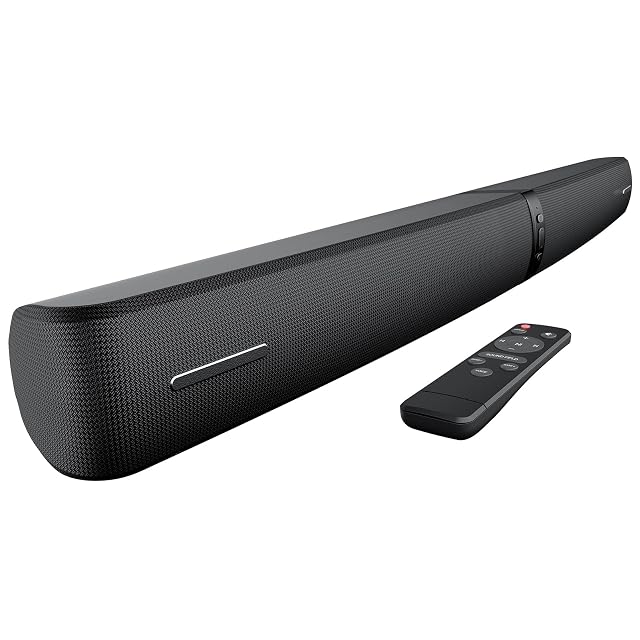
The B4208’s one distinguishing claim is a slanted low-profile body with a metal grille and integrated wall brackets. If the shape is what you are buying, that is what the money is for.
And against Philips’s own cheapest, the B4000 at $75.10: this costs $2.89 more and doubles the power while adding both formats.
So on this shelf the cheapest sensible Philips is the one in the middle.
What Dolby Digital Plus actually buys
Not Atmos — something more immediately useful.
Dolby Digital Plus is channel-based: each sound is assigned to a fixed speaker position, and the bar renders those positions from the drivers it has. Dolby Atmos is object-based: sounds are placed at points in space, height included, and the system decides which drivers produce them.
Why the channel-based one matters more at this price: Dolby Digital Plus is what broadcast television, most streaming services and nearly every Blu-ray actually send. A bar that decodes it receives the real surround mix. A bar that cannot gets a stereo downmix — or, as the Assistrust KY2023 on this shelf admits in its own bullets, asks you to switch Dolby off at the source entirely.
And what DTS Virtual:X does not buy
You don’t need extra speakers.
True, and worth reading precisely. Virtual:X uses psychoacoustic processing so sound seems to extend above and beside the bar, with no driver pointed at the ceiling. The effect is a wider, taller-seeming stage rather than sound from overhead.
The channel count makes the limit plain: a count reads front.sub.height, and 2.0 has no third number. The Majority Sierra on this shelf is 2.0.2 — two real height drivers and genuine Dolby Atmos — at $139.95.
One hundred and twenty watts, and the shelf-wide caveat
Ten of the twelve bars here publish a maximum, and this is one. Only the Majority Sierra publishes RMS — a continuous rating, and the only comparable number on the shelf.
So read “120 W max” as a class, not a measurement. And note that Sony, Amazon and Bose publish no wattage at all.
What is not published
No driver count and no driver size — none of the four Philips bars publishes either. Suntrok gives diameters; Bose names two full-range drivers and a center tweeter.
No subwoofer. Hisense at $119.99 includes a wireless one and the B5306 at $117.94 does too — both for about forty dollars more than this.
No HDMI cable stated in the box, where Amazon, Hisense, Majority and Suntrok include one.
1,928 g and 91 × 766 × 67 mm are published.
Availability
At the check, the American Amazon store stood at roughly $78.
These numbers are what Keepa carried on the day this page was last built. Stock and prices move without notice.
Prices quoted in this text were read on 4 October 2026. The live price is at the top of the page.
What gets asked most
How can it cost less than the B4208 and do more?
There is no technical explanation in the listings, only the figures — and they are unambiguous. This B5109 at $77.99: 2.0 channel, 120 W max, Dolby Digital Plus, DTS Virtual:X, four EQ modes, Night Mode, Philips app, HDMI ARC plus optical plus AUX plus USB, Bluetooth 5.4 with LE Audio. The B4208 at $117.38: 2.0 channel, 60 W max, no Dolby, no DTS, HDMI ARC plus AUX plus USB plus optical, Bluetooth 5.3. So the dearer bar has half the power, neither surround format and older Bluetooth, for $39.39 more. Its one distinguishing claim is a "unique slanted and low-profile" body with a metal grille and integrated wall brackets. If the design is what you want, that is what the money buys.
What does DTS Virtual:X give a 2.0 bar?
Processed height and width from two drivers, and Philips is reasonably plain about the mechanism. The bullet says: "With DTS Virtual, you can enjoy immersive 3D audio, and don’t need extra speakers!" — which is accurate. Virtual:X applies psychoacoustic processing so that sound seems to extend above and beside the speakers, without any driver pointed at the ceiling or the side walls. The result is a wider, taller-seeming stage; it is not sound arriving from overhead. Worth knowing where the limit is: on a 2.0 bar there is no third number in the channel count and so no height driver. The Majority Sierra on this shelf is 2.0.2 — two genuine height channels and real Dolby Atmos — for $139.95.
Is Dolby Digital Plus different from Dolby Atmos?
Yes, and the difference is how sound is placed. Dolby Digital Plus is channel-based: each sound is assigned to a fixed speaker position — left, center, right, surrounds — and the bar renders those positions as best it can from the drivers it has. Dolby Atmos is object-based: a mixer places a sound at a point in three-dimensional space, height included, and the system works out which drivers should produce it. Decoding Dolby Digital Plus matters practically, because it is what broadcast television, most streaming services and almost every Blu-ray actually send — so a bar that decodes it gets the full surround mix rather than a stereo downmix. On this shelf only the Majority Sierra claims Atmos, and only this Philips and the Hisense name a Dolby format at all under $140.