Skip to content

Bose TV Speaker review

A compact 2.0 soundbar with two angled drivers and a center tweeter aimed at speech clarity.

The closing call Two hundred and seventy-nine dollars for two channels, no subwoofer, no HDMI cable and no wall brackets — and the most precise dimensions on the shelf, down to the remote’s weight. It publishes no wattage at all.

What the maker puts in writing

  • “Designed with simplicity in mind, the Bose TV Speaker is an all-in-one soundbar that clarifies speech and is a simple fix for better TV sound”
  • “2 angled full-range drivers deliver a more realistic, spatial audio experience”
  • “A single connection from this compact soundbar to the TV via an optical audio cable (included) or an HDMI cable (sold separately)”
  • “This small soundbar is just over 2” tall for easy placement in front of your TV or mounted to a wall (wall brackets sold separately). Overall TV speaker dimensions are 2.21” H x 23.38” W x 4.02” D; Remote Control: 4.1” H x 1.6” W x 0.5” D (0.07 lb)”
  • “Compatible with the Bose Bass Module 500 or 700 and requires the Bose Bass Module Connection Cable or a standard 3.5 millimeter audio cable, sold separately. Power cord: 5 ft”
  • Description: “a center tweeter specifically focused on elevating vocals” and “built-in Dolby decoding”

The center tweeter is the reason this exists

Two full-range drivers angled to deliver wide, spacious sound and a center tweeter specifically focused on elevating vocals.

Nothing else on this shelf has one, and it addresses the commonest complaint about television sound directly.

In an ordinary 2.0 bar — nine of the twelve here — dialogue is summed into the left and right drivers. The voice floats at a vague point between them and competes with the music and effects coming out of those same cones.

A dedicated center driver puts speech physically in the middle, under the picture, with its own cone. It is the same principle a cinema uses, where the center speaker sits behind the screen.

And the remote adds a dialogue mode on top of it. So the bar attacks speech twice.

The angled drivers are the other sensible detail: a bar sitting in front of a television fires at a seated listener’s chest or knees unless the drivers are tilted up.

What two hundred and seventy-nine dollars does not include

Three things, each stated in the listing:

The HDMI cable — “an optical audio cable (included) or an HDMI cable (sold separately)”. The wall brackets — “mounted to a wall (wall brackets sold separately)”. The bass module cable — “requires the Bose Bass Module Connection Cable or a standard 3.5 millimeter audio cable, sold separately”.

Against the same shelf:

Hisense, $119.99 — HDMI cable and a wireless subwoofer. Suntrok, $81.21 — HDMI ARC cable, RCA-to-3.5 mm, USB cable, wall screws, a subwoofer and two wireless microphones. Majority, $139.95 — HDMI cable and a wall mount kit. Three Philips bars — integrated wall brackets.

The pattern across this shelf is consistent: the cheap bars include the cable, the premium names sell it. Sony at $98 does the same — optical in the box, HDMI ARC in the sales copy.

Optical works, and carries stereo and compressed Dolby fine. What it cannot do is pass the television’s volume control to the bar, which is the main convenience ARC exists for.

Dimensions to the hundredth of a pound, and no wattage at all

Overall TV speaker dimensions are 2.21” H x 23.38” W x 4.02” D; Remote Control: 4.1” H x 1.6” W x 0.5” D (0.07 lb). Power cord: 5 ft.

That is the most precise dimensional disclosure on the shelf — and it sits beside no power figure, no driver size and no frequency response.

Sony and Amazon publish no wattage either. Every brand you have not heard of here does: Philips 60, 120, 140 · Assistrust 80, 90 · Hisense 240 · Suntrok 240 peak.

The defensible part: nine of those ten are peak figures, which cannot be compared with each other. Only the Majority Sierra publishes RMS — a continuous rating — which makes its 120 W probably the most powerful bar on this shelf despite reading half of Hisense’s 240.

A number nobody can compare is worth little more than no number. Publishing the power cord’s length instead is still a choice.

And no bass, unless you buy more

2.0 channels, no subwoofer. A cabinet 4.02 inches deep cannot move enough air below roughly 100 Hz, so explosions, bass lines and the weight under a voice are thin.

Bose’s answer is the Bass Module 500 or 700 — plus a connection cable, both separate purchases.

Hisense at $119.99 includes a wireless subwoofer. The Philips B5306 at $117.94 includes a wireless subwoofer. Both are less than half this price.

So the honest position: buy this for speech, which it does in a way nothing else here attempts. Do not buy it for bass, and budget for the HDMI cable.

1,969 g is published.

Availability

At the check, the American Amazon store stood at roughly $280.

These numbers are what Keepa carried on the day this page was last built. Stock and prices move without notice.

Prices quoted in this text were read on 4 October 2026. The live price is at the top of the page.
In its favor, and against it

Strengths

  • A dedicated center tweeter for vocals, which no other bar on this shelf has
  • The most precise dimensions published here, including the remote’s size and weight
  • Two angled drivers, so the output is aimed at a seated listener rather than straight ahead

Compromises

  • No HDMI cable, no wall brackets and no bass module cable — all sold separately, at $279
  • Two point zero channels and no subwoofer, where Hisense at $119.99 includes a wireless one
  • No power figure, no driver size and no frequency response

Specifications

Drivers2 angled full-range, plus a Center TWEETER for vocals
DialogueA dialogue mode on the remote, on top of the dedicated tweeter
BassA bass boost on the remote
DecodingBuilt-in Dolby decoding, stated
InputsHDMI, optical in and AUX in, connecting up to 3 devices
Supplied cableOPTICAL only — the HDMI cable is sold separately
Wall bracketsSOLD SEPARATELY
Bass moduleCompatible with the Bose Bass Module 500 or 700, cable sold separately
Dimensions2.21 in H × 23.38 in W × 4.02 in D
Remote dimensions4.1 × 1.6 × 0.5 in, 0.07 lb — published, see the FAQ
Power cord5 ft
Weight1969 g (69.5 oz)
PowerNOT PUBLISHED — no wattage anywhere
SubwooferNone included
Amazon referenceB088KRPCQJ
EAN0017817808675

What gets asked most

What does the center tweeter actually do?

It gives speech its own driver, and it is the one thing on this shelf that nothing else has. Bose’s description reads: "two full-range drivers angled to deliver wide, spacious sound and a center tweeter specifically focused on elevating vocals." In an ordinary 2.0 bar — nine of the twelve here — dialogue is summed into the left and right drivers, so the voice appears to float at a vague point between them and competes with the music and effects coming out of the same cones. A dedicated center driver places speech physically in the middle, under the picture, with its own cone. That is the same principle a cinema uses, where the center speaker sits behind the screen. Add the dialogue mode on the remote and this bar addresses speech twice over, which is precisely what it is sold for.

What is not in the $279 box?

Three things, each named in the listing. "A single connection... via an optical audio cable (included) or an HDMI cable (sold separately)" — so the cable for the better connection is a separate purchase. "Mounted to a wall (wall brackets sold separately)". And "compatible with the Bose Bass Module 500 or 700 and requires the Bose Bass Module Connection Cable or a standard 3.5 millimeter audio cable, sold separately". For comparison on the same shelf: Hisense at $119.99 includes an HDMI cable and a wireless subwoofer. Suntrok at $81.21 includes an HDMI ARC cable, an RCA-to-3.5 mm (0.20 in) cable, a USB cable, wall screws, a subwoofer and two wireless microphones. Majority at $139.95 includes an HDMI cable and a wall mount kit. Three Philips bars have integrated wall brackets.

Why publish the remote’s weight and no wattage?

It is the oddest disclosure pattern on the shelf, and the pattern is consistent across the premium brands. Bose publishes "Overall TV speaker dimensions are 2.21" H x 23.38" W x 4.02" D; Remote Control: 4.1" H x 1.6" W x 0.5" D (0.07 lb)" and a "Power cord: 5 ft" — precision down to the hundredth of a pound on an accessory. It publishes no power figure, no driver size and no frequency response. Sony and Amazon also publish no wattage. Every brand you have not heard of here does: Philips 60, 120 and 140 W, Assistrust 80 and 90 W, Hisense 240 W, Suntrok 240 W peak. The defensible part is that nine of those ten are peak figures and so not comparable with one another — only the Majority Sierra publishes an RMS rating. A number nobody can compare is close to no number.

Against the home cinema devices in the same bracket

Between home cinema devices of the same category and nearby price. Shown: what they all state. A half-filled column says nothing.

Model Price WeightSubwoofer
Bose TV Speaker $280 1969 g (69.5 oz)None included
Majority Sierra $140 3552 g (125.3 oz) — exactly the 7.83 lb it publishesNone
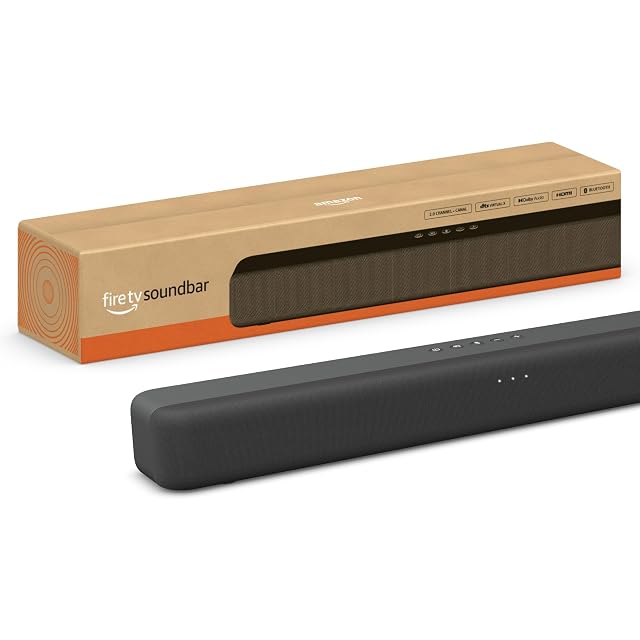
Amazon Fire TV Soundbar $120 1801 g (63.5 oz)None, and none offered as an add-on
Philips B5306 (TAB5306/37) $120 Not publishedWireless — so it can be placed where the bass works

What the models do not share, in home cinema devices

  • If price decides: Amazon Fire TV Soundbar, at $120.

Who should pick this one, among home cinema devices

Dialogue, and only dialogue — a center tweeter nothing else here offers

What buyers actually choose

Amazon reports what buyers took in the month before this page was last checked: at least 2,000.

The figure is a floor, rounded by Amazon, and read through Keepa — it says what buyers picked, not what a maker claims.

Sources

Specifications: the manufacturer sheet for home cinema gear and the matching Amazon product page. Prices and availability: Keepa. Every figure on this page names its source.

The method applied to these home cinema devices