What the maker puts in writing
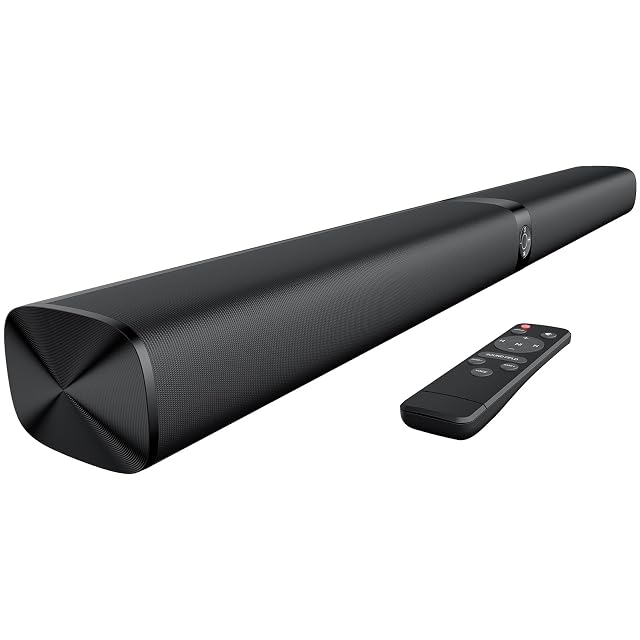
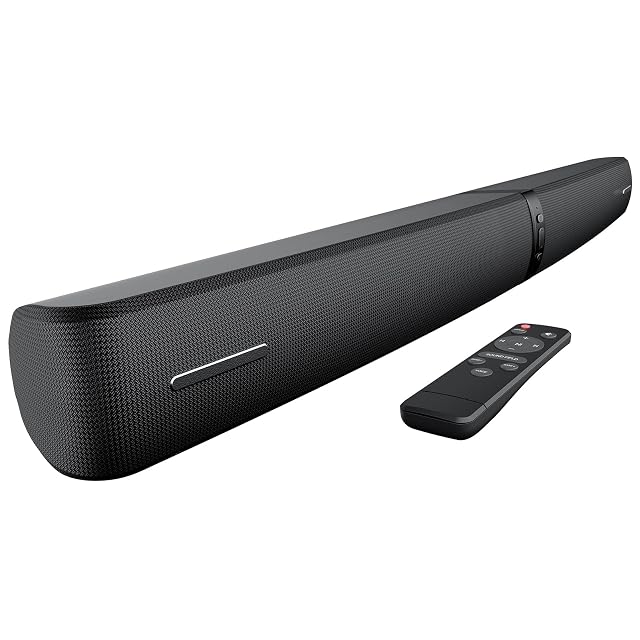
- “Upgrade your TV sound instantly with the 2 powerful speakers and a wireless subwoofer that deliver 240W max audio power”
- “DTS Virtual X enhances the entertainment you love across all of your devices… the breakthrough spatial sound experience”
- “A wireless subwoofer delivers the robust low-end frequencies… without any messy wires. You’ll feel the ‘boom’ while the two front-facing speakers project bright, clear high- and mid-range frequencies”
- “With HDMI ARC, the Hisense HS2100 can connect to your TV through a single HDMI cable (included), connect wirelessly via Bluetooth, and control both with one remote”
- “All with a simple touch of the remote with 6 preset sound modes”
- “The Hisense 2.1 channel Soundbar with Dolby Audio™… An impressive 240W of total output power”
At a hundred and twenty dollars it simply includes more
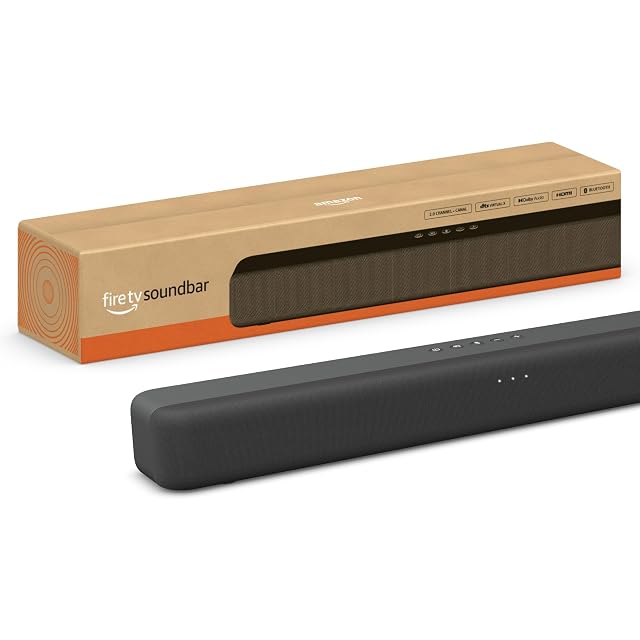
Amazon’s Fire TV Soundbar sits at exactly the same price. Side by side:
Amazon, $119.99 — 2.0 · no subwoofer · DTS Virtual:X + Dolby Audio · HDMI cable included · no power figure · no EQ modes · 24 in long, 2.5 in high
Hisense, $119.99 — 2.1 with a wireless subwoofer · 240 W max · DTS Virtual:X + Dolby Audio · HDMI cable included · 6 EQ modes · EZ Play
The same money, plus a separate powered bass cabinet and six presets.
The Amazon’s case is the body — shorter and lower — and tighter integration with a Fire TV.
The wireless subwoofer is the reason to buy it
Two things stack here.
First, having a subwoofer at all. A bar 61 mm deep has neither the cone area nor the enclosure volume to reproduce a 50 Hz note, so everything below roughly 100 Hz is absent: explosions, bass lines, the weight under a voice. A separate cabinet does nothing else, which is why it does it well.
Second, wireless. Bass wavelengths are meters long and interact with the room to create standing waves — spots where bass piles up and spots where it nearly disappears. Move a subwoofer three feet and it sounds different. Wireless means it only needs a socket, so it can go where the bass is even rather than where the cable reaches.
Two bars here are wireless: this and the Philips B5306 at $117.94. The Suntrok at $81.21 states a wired subwoofer twice in its own bullets.
Six equaliser modes, the most on this shelf
Three Philips bars have four (Music, Movie, Voice, Stadium). Both Assistrust bars have three. The Majority has four. Amazon and Sony state none.
What presets are actually for: a film mix and a news broadcast have very different balances, and a bar tuned for one sounds wrong on the other. More presets means less fiddling with treble and bass by hand.
Two hundred and forty watts, and why that is smaller than it reads
This is the central caution for the whole shelf.
Hisense publishes “240W max”. The Majority Sierra publishes “120W RMS”. Those are different quantities.
A maximum or peak figure is a momentary ceiling, usually measured generously and with no distortion limit stated. An RMS figure is continuous — power the amplifier can sustain.
As a rough industry pattern, peak ratings run two to four times the continuous figure for the same hardware. So 240 W peak may correspond to somewhere near 60 to 120 W continuous, and the Majority’s 120 W RMS is probably the more powerful bar.
Ten of the twelve bars here publish max or peak. The Majority alone publishes RMS. Sony, Amazon and Bose publish no figure at all.
Dolby Audio, not Atmos
Dolby Audio is the umbrella name for Dolby’s channel-based formats — Digital, Digital Plus, TrueHD — where each sound is assigned to a fixed speaker position.
That is genuinely useful, because it is what broadcast television, most streaming and nearly every disc actually send: the bar gets the real mix rather than a stereo downmix.
What it is not is overhead sound. The channel count says the same thing — 2.1 has no third number, so no height driver. Only the Majority Sierra on this shelf is 2.0.2 with genuine Atmos.
What is not published
No driver sizes, front or subwoofer. Suntrok at $81.21 publishes two 2.5-inch front drivers and a 5.5-inch subwoofer — the only diameters on this shelf.
No enclosure type, where Sony names a bass reflex cabinet.
2,223 g and 89 × 800 × 61 mm are published.
Availability
At the check, the American Amazon store stood at roughly $115.
These numbers are what Keepa carried on the day this page was last built. Stock and prices move without notice.
Prices quoted in this text were read on 4 October 2026. The live price is at the top of the page.