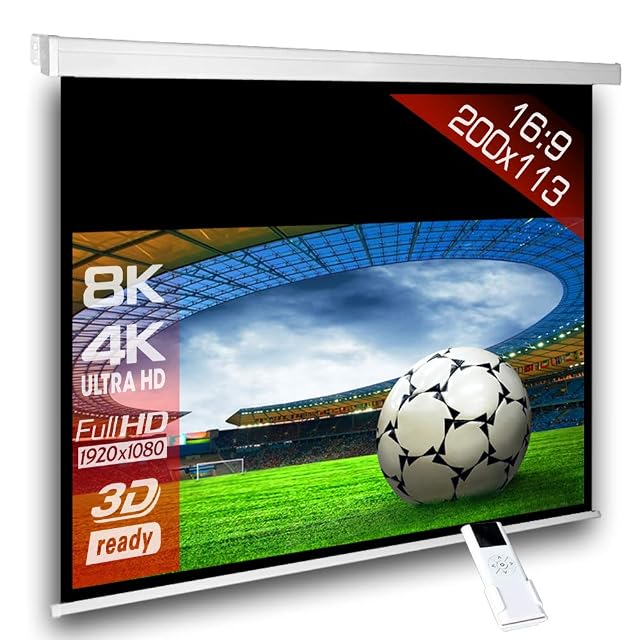
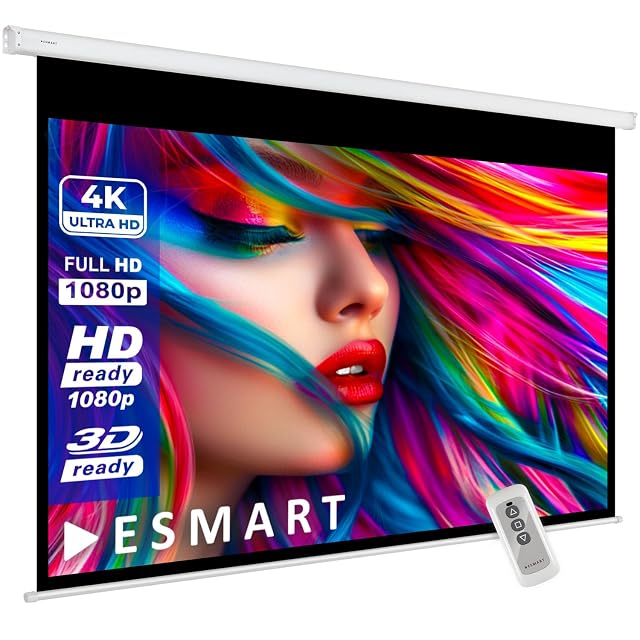
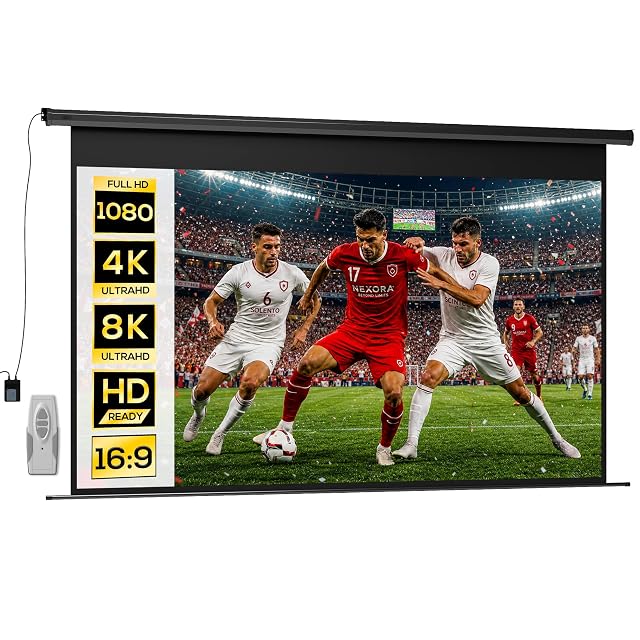
The bottom line A lot of surface for the money, in a format that has to be a choice rather than a default — read the aspect ratio first.
The format, before anything else
4:3. A 16:9 film shown on it uses the full width and leaves unused fabric above and below. That is not a fault and it is a decision: the screen is taller than a film needs, which suits mixed use and wastes surface for a pure cinema room.
What motorised buys
The wall, back, when the film ends. In a room that is also a living room that is the whole argument, and it is why this mechanism costs more than a pull-down.
The feature that would make it feel finished
A 12 V trigger — an input that follows the projector so the screen descends when the machine powers up. It is not stated here, which means a second remote for the screen.
The flatness question
No tab tensioning is stated. Tab-tensioned screens pull the fabric sideways with cords as it descends and stay markedly flatter; without it, expect some waviness near the sides. On a long-throw projector that is minor; with a short-throw machine it becomes visible.
Sizing
240 × 180 cm of image. Add the casing to the width before measuring the wall, and remember that the black drop above the image sets how high the picture sits.
Availability
On sale at around 135 € on the German, French and Spanish Amazon stores at the time of checking.
The French and Spanish Amazon listings are priced above 1.6× the cheapest store, which is normally a reshipping offer rather than a local price; they are left out of the range above.
Listed but with no offer on the British Amazon store — the reference exists there and nobody is currently selling it.
Not found on the American and Italian Amazon stores, where the buy link falls back to a local search rather than to a page that does not exist.
Prices and availability are what Keepa reported on the date this page was updated; both move.
Prices quoted in this text were read on 4 September 2026. The live price is at the top of the page.
What we like, and what we don't
Strengths
A large image — 240 cm wide — at a price where fixed frames are much smaller
Motorised, so the wall comes back when the film ends
Image dimensions published in centimetres, not only as a diagonal
Compromises
4:3 rather than 16:9: films will letterbox, and the screen has to be chosen for that deliberately
No tab tensioning stated, so expect some waviness near the edges
No gain figure published
Specifications
Image size
240 × 180 cm, 120 inch diagonal — stated
Format
4:3 — stated
Mechanism
Motorised — stated
Gain
Not published in this listing
Tab tensioning
Not stated
Amazon reference
B00MN5N34U (same reference on 4 Amazon marketplaces)
EAN
4260094735905
Questions people actually ask
Should I buy a 4:3 screen for films?
Only deliberately. A 16:9 film on a 4:3 screen uses the width and leaves black bands above and below, which wastes surface but does not harm the image. Where 4:3 makes sense is mixed use — presentations, older material, or a room where the extra height is useful.
Will it be flat?
Mostly, and not perfectly. Without tab tensioning, fabric hanging from a roller keeps some memory of being rolled, most visibly near the sides. Leave it fully extended for a week before judging it.
The motorised member of a range that publishes total width across every mechanism — which is what lets you compare a roller screen with a fixed frame properly.
Best for: A wall with a hard width constraint, where the screen has to disappear and the total dimension is what has to fit.