What the maker puts in writing
- “NOTE: This product was designed for older televisions with Stereo Audio connectors or a headphone jack: newer televisions with HDMI or Digital Optical should instead use headphone model WH-L600”
- “Requires use of RCA Audio Out or Headphone Jack on television”
- “For Static sound issue, please refer the ‘trouble shooting steps’”
- 1.57 inch drivers · up to 20 hours · up to 150 ft
- Voice mode · noise reduction system
- In the box: WHRF400R Headphones, TMRRF400 Transmitter, AC Adaptor, Stereo Mini Cable, RCA Plugs Adaptor, Rechargeable Battery
- Catalog weight 277 g (9.8 oz) · Dimensions 249 × 184 × 343 mm (9.80 × 7.24 × 13.5 in)
Read the description before the price
“newer televisions with HDMI or Digital Optical should instead use headphone model WH-L600.”
That is a maker naming a different product from its own range as the one you should buy. Nothing else on this shelf does anything comparable, and it should be taken at face value.
The bullet states the same thing as a hard requirement: “Requires use of RCA Audio Out or Headphone Jack on television.”
So the decision is made by the back of your television:
An RCA pair, or a headphone socket — this works, and works well.
Only HDMI and optical — it does not, and no adapter rescues it. What is missing is an analog audio output, not a plug shape.
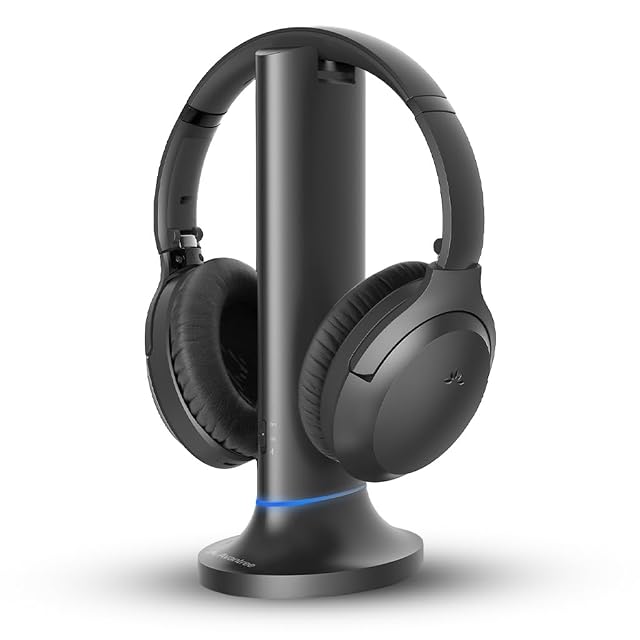
Televisions sold in recent years increasingly have neither RCA nor a headphone jack. If yours is one of them, the products here that will connect are: all three Earbay listings, which supply optical, RCA and AUX cables together; the Holdsound and 1Mii transmitters, which take optical; and the Avantree at $159.99, the only one here with HDMI ARC.
No delay at all, which is the thing nobody advertises
This is the real argument for an older technology, and Sony leaves it unsaid.
The link is analog RF. An analog radio link has no buffer — nothing to fill, nothing to decode, nothing to re-clock. The sound arrives as fast as the electricity moves.
Which is why none of the three Sony listings here publishes a latency figure, while five cheaper products are proud of staying under 40 ms:
Earbay ×3 — under 40 ms · 1Mii — less than 40 ms · Holdsound — under 40 ms
Sony ×3 — nothing published · Sennheiser ×3 — nothing published
Forty milliseconds is a genuinely good threshold. It is roughly where the eye begins to catch that a voice does not match a mouth, and it is far better than ordinary Bluetooth, which on the SBC codec runs 150 to 250 ms and is unwatchable on a talking face.
But zero is better than forty, and the three products on this shelf with the least delay are the three publishing no number.
What the analog link costs
“For Static sound issue, please refer the ‘trouble shooting steps’.”
That bullet is the price of the advantage above, and it is honest of Sony to include it.
Analog radio fails the way FM radio fails: gradually, into hiss and crackle, as the signal weakens or something interferes. There is a noise reduction system on board and a range of 150 feet, but at the edge of that range, or through two walls, the sound goes noisy rather than cutting out.
A digital link behaves the opposite way: perfect until it isn’t, then silent.
That trade is the central choice on this shelf, and the Sennheiser RS 120-W at $159.95 sells itself on exactly this line: “Digital wireless transmission ensures no analog static.”
Three technologies, three groups:
Analog RF — the three Sony RF400 listings.
Digital proprietary — the three Sennheisers, one of which also claims “advanced LE Audio transmission”.
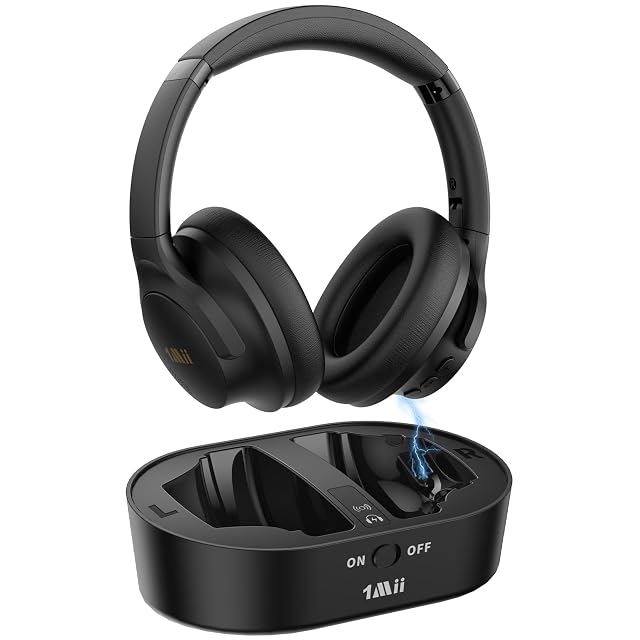
Bluetooth — the three Earbay (5.4), the Holdsound (5.3), the 1Mii (6.0 claimed), the Avantree.
Two hundred and seventy-seven grams, and a published driver size
277 g is a plausible, usable figure, and it is the weight to trust for this model.
The renewed listing of the same WHRF400 publishes 1361 g (48 oz) — exactly 3.00 lb — which is the box: headphones plus TMRRF400 transmitter plus AC adaptor plus cables. The $189.99 bundle publishes 277 g (9.8 oz) again.
The shelf, for scale: Holdsound 250 g (8.8 oz) · Earbay 255 g (9 oz) · Sony 277 g (9.8 oz) · Sennheiser RS 175,310 g (6183.9 oz) · RS 195,454 g (6894.4 oz) (exactly 1.00 lb). Four listings publish nothing.
And 1.57 inch drivers — about 40 mm (1.57 in) — is the only driver diameter published anywhere on this shelf. Not the Sennheisers, not the Earbay listings, not the Avantree. Forty millimeters is a normal full-size headphone unit, which says this is a proper over-ear design.
Voice mode, and what the expensive Sennheiser lacks
Voice mode is the feature this whole category exists for: lifting speech out of a soundtrack so dialogue is intelligible without raising everything.
Where the shelf stands:
Sennheiser RS 120-W, $159.95 — “Speech, Music, Neutral”
Sennheiser RS 195, $264.03 — Speech Mode, Music Mode
1Mii, $89.99 — TV, Movie, Music
Sony, here — Voice Mode
Sennheiser RS 175, $249.95 — Bass Boost, Surround Sound
The last line is the striking one: the $249.95 RS 175 has no speech mode at all, on a shelf sold almost entirely on dialogue clarity for people who struggle to hear it.
The noise reduction system here is unrelated — it addresses hiss in the radio link, not noise in the room.
A box list that is actually a list
WHRF400R Headphones, TMRRF400 Transmitter, AC Adaptor, Stereo Mini Cable, RCA Plugs Adaptor, Rechargeable Battery.
Six items, named, with model numbers on the two that have them. That is more than most of this shelf manages, and it answers the question that matters: the transmitter and the battery are included.
Worth comparing with the $189.99 bundle of the same headphones, whose own box list reads “Sony Wireless Home Theater Headphones Black - AC Adaptor - Stereo Mini Cable - RCA Plugs Adaptor” — no transmitter and no rechargeable battery named, on a product that cannot work without the first.
The same headphones, three prices
$91.88 — renewed, same WHRF400, same dimensions, same description.
$138 — this listing, new.
$189.99 — new, bundled.
The $51.99 above this listing buys: unspecified in-ear headphones whose color “May Vary”, a hard case, a one-year protection plan, and two USB-C-to-USB-A adapters for a port the RF400 does not have — it charges on the transmitter dock from the AC adaptor, and its own box list contains no USB item at all.
What is not published
No latency figure, though it has the least on the shelf.
No frequency response and no signal-to-noise ratio. The Sennheiser RS 195 is the only product here publishing a measurement: “Analog input: typ. 85 dBA at 1 Vrms, Digital input: > 90 dBA”.
No volume limit, on a product sold for dialogue amplification. Only the Avantree at $159.99 addresses the subject, and it does so by stating a limit — “not for users with severe hearing loss or those needing hearing-aid-level amplification”.
And the rechargeable battery is not a user-serviceable cell. Only the Sennheiser RS 120-W publishes replaceable ones — “Two rechargeable batteries: 1.2 V (AAA), NiMH” — and on a shelf where ten of twelve products are sealed, that is the quiet difference between a few years and a decade.
Availability
At the check, the American Amazon store stood at roughly $140.
These numbers are what Keepa carried on the day this page was last built. Stock and prices move without notice.
Prices quoted in this text were read on 4 October 2026. The live price is at the top of the page.