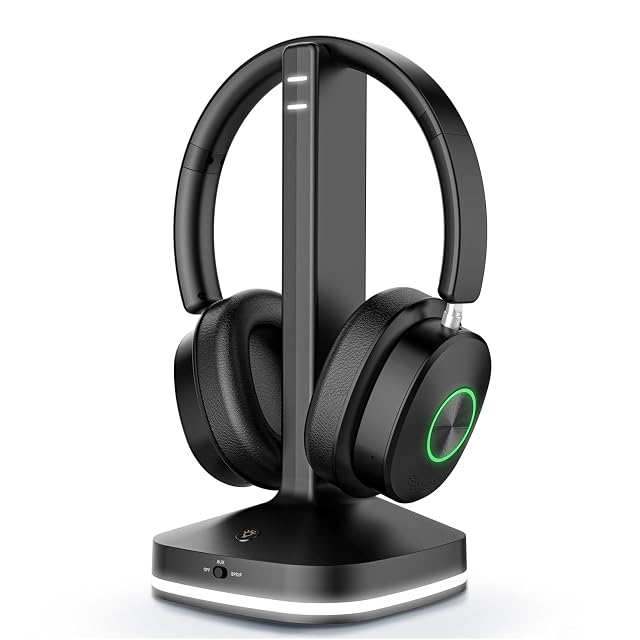
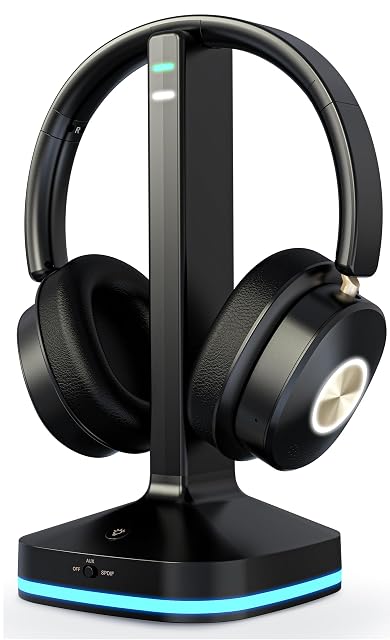
What the maker puts in writing
- “Wireless TV Headphones with HDMI ARC Input”, supporting “HDMI ARC, Optical, and AUX audio output”
- “【Check TV Compatibility Before Purchase】… please confirm your TV has one of these ports and check whether it is already in use before purchasing”
- “【Volume Boost for Seniors】… suitable for seniors but not for users with severe hearing loss or those needing hearing-aid-level amplification”
- “【OPT Soundbar Passthrough Only】For TVs with soundbars, the transmitter supports Optical (OPT) passthrough… HDMI soundbar passthrough is NOT supported”
- “ideal for seniors or viewers who struggle to hear TV dialogue… without increasing the TV volume for others”
- “can also be used independently as wireless Bluetooth headphones”
Of twelve listings, one has HDMI ARC, and it is this one.
That matters because of what televisions now offer. Older sets had RCA outputs and a headphone jack; current ones have optical and HDMI ARC, and frequently neither analog option.
The consequence is written into the Sony listings here. The RF400 at $138 states it in its own description: “designed for older televisions with Stereo Audio connectors or a headphone jack: newer televisions with HDMI or Digital Optical should instead use headphone model WH-L600.” Three of the twelve products on this shelf are that same RF400.
The Sennheiser RS 120-W at $159.95 — four cents less than this — publishes a stereo RCA cable and a 3.5 mm (0.14 in) adapter, and no optical input at all.
The three Earbay listings supply optical, RCA and AUX, which covers most sets.
Only this one takes HDMI ARC, which is the connection a television bought in the last few years is most likely to have free and working.
Three bullets out of five are limitations, and that is the point
This is the most honest listing on the shelf by a wide margin, and the honesty is specific rather than decorative.
One: check the port is free. “confirm your TV has one of these ports and check whether it is already in use.”
That is the obstacle that defeats most purchases in this category, and nobody else here mentions it. A television has one optical output and usually one HDMI ARC port. If a soundbar occupies either, there is nothing left — so you unplug the soundbar for the headphones, and the headphones for the soundbar.
Two: passthrough works on optical only. “the transmitter supports Optical (OPT) passthrough… HDMI soundbar passthrough is NOT supported.”
A specific, verifiable limit on its own solution. Connected by optical, the soundbar keeps playing while the headphones work. Connected by HDMI, it does not.
The 1Mii at $89.99 is the only other listing here with the same idea, as a bypass mode — and it goes further, because its output also feeds “another ClearlinkTV H3”, which gives two listeners independent volume.
Three: it is not a hearing aid. “suitable for seniors but not for users with severe hearing loss or those needing hearing-aid-level amplification.”
Eleven listings on this shelf sell dialogue clarity to seniors. This is the only one that states where that stops.
Volume without the household paying for it
“ideal for seniors or viewers who struggle to hear TV dialogue… without increasing the TV volume for others.”
That is the honest description of what this entire category is for, and it is better written here than anywhere else on the shelf.
The problem is never simply volume. It is that one person needs the dialogue loud and everyone else in the room does not, so the television gets turned up until it is uncomfortable for four people to serve one.
Headphones separate the two. One person hears clearly; the room stays as it was.
And the limit on that benefit is stated in the same bullet: headphones raise everything together, where a hearing aid applies frequency-specific gain matched to a measured audiogram. If the need is genuine hearing loss rather than a noisy room or a mumbled soundtrack, this is not the solution, and the listing says so.
The nearest thing on this shelf is the Sennheiser RS 195 at $264.03, which offers “a customized hearing profile” — a step in that direction, though not a medical device either.
Also Bluetooth headphones, which is worth more than it sounds
“can also be used independently as wireless Bluetooth headphones.”
Most products here are a television accessory and nothing else: the headphones only work with their own transmitter, and away from the television they are a paperweight.
This pair also connects to a phone or a tablet. For anyone who would otherwise own two sets, that is one fewer thing to charge and keep track of — and it makes the $159.99 read differently.
What it does not publish, and what that costs
This is the trade, stated plainly.
No range. The Sennheiser RS 120-W publishes 60 m, the Holdsound 50 m, the Sony 150 ft, the Earbay 30 m.
No battery life. The 1Mii publishes 75 hours, the Earbay and Holdsound 40, the Sony and RS 120-W 20.
No latency figure. Five cheaper listings publish under 40 ms — the threshold where the eye catches a voice not matching a mouth. Standard Bluetooth on SBC runs 150 to 250 ms and is unwatchable on a talking face, so on a Bluetooth product this silence is a real gap.
No weight, no driver size, no frequency response, no sound modes, no codec.
What it publishes instead is the inverse of this shelf: what it will not do.
Both kinds of information matter. Numbers tell you whether it reaches the kitchen and whether lips stay in sync. Limits tell you whether it will connect at all, and whether it will help.
If your television has HDMI ARC and a soundbar on the optical port, this is the only listing here that has thought about your situation. If you want figures, the Sennheiser RS 120-W at $159.95 publishes a complete parts list, 60 m (197 ft), three named profiles — and replaceable AAA cells, which is the only battery on this shelf you can change.
Availability
At the check, the American Amazon store stood at roughly $160.
These numbers are what Keepa carried on the day this page was last built. Stock and prices move without notice.
Prices quoted in this text were read on 4 October 2026. The live price is at the top of the page.