What the maker puts in writing
- “Up to 20 hours playback from the rechargeable AAA batteries”
- In the box: “Headphones HDR 120-W, Transmitter TR 120-W with stereo RCA audio cable, Mains unit with country adapters (EU, UK, US, AUS), Two rechargeable batteries: 1.2 V (AAA), NiMH, Adapter for audio connection 3.5 mm (0.14 in), Quick guide & safety guide”
- “Three listening profiles - Speech, Music, Neutral”
- “Digital wireless transmission ensures no analog static”
- “advanced LE Audio transmission”
- “Up to 60m (197 ft) range”
- “Lightweight on-ear headphones with low headband pressure”
- Catalog weight: 695 g (24.5 oz)
Two AAA cells, which is the reason to buy this one
“Two rechargeable batteries: 1.2 V (AAA), NiMH.”
This is the only product on the shelf whose battery you can replace, and it is the single most consequential difference between these twelve listings.
A sealed lithium cell is what ends the life of wireless headphones. It loses capacity with every charge cycle, and with age whether used or not. After three to five years, a set that ran twenty hours runs eight, then four, then lives on the charger. Then it is rubbish — working drivers, working radio, dead battery, no way in.
On the other eleven listings here, including the $264.03 Sennheiser RS 195 and all three Sony RF400 listings, that is the ending.
Here you buy two AAA NiMH cells for a few dollars from any shop, and the headphones carry on.
On a product that is very often bought for an elderly relative and expected to last, this matters more than the 75-hour figure on the 1Mii at $89.99 or the 310 g (10.9 oz) on the RS 175.
Sixty meters, second only to the RS 175
Up to 60 m, second on the shelf:
Sennheiser RS 175 — 100 m · Sennheiser RS 120-W — 60 m
Holdsound — 50 m (164 ft)
Sony RF400 ×3 — 150 ft (46 m)
Earbay ×3 — 30 m (100 ft) · 1Mii — 100 ft
Sennheiser RS 195, Avantree — nothing published
Sixty meters is not about sitting further back. It is about leaving the room — the kitchen, a corridor, the garden — with the program still playing. Thirty meters keeps you where you were.
Radio figures always describe open air, and walls cut them hard. But the ordering holds, and the gap between sixty and thirty is real.
Worth noting that the two Sennheisers above this one in price publish no range figure at all.
Three profiles, named — including a speech mode
Speech, Music, Neutral.
Naming them is what makes them checkable, and the choice of three is the right three. Speech lifts the midrange where voices sit and trims the bass that masks them — the actual reason most people buy television headphones. Music widens it. Neutral leaves it alone.
Against the rest of the shelf:
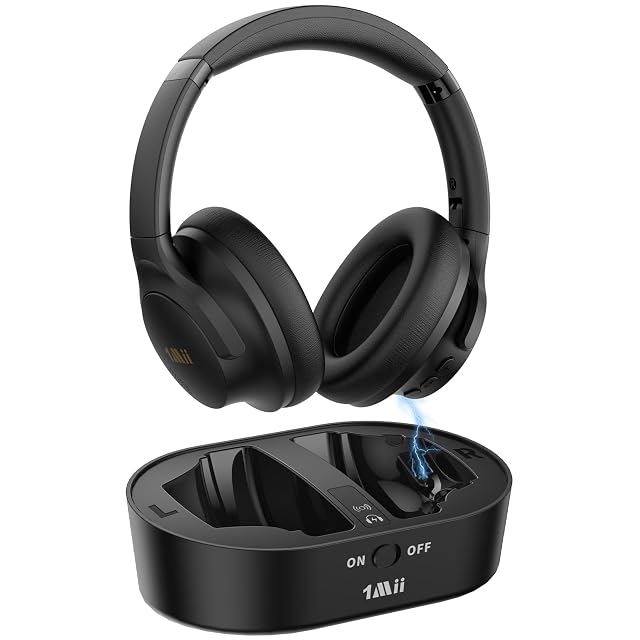
1Mii, $89.99 — TV, Movie, Music
Sennheiser RS 195, $264.03 — Speech Mode, Music Mode
Sony RF400 — Voice Mode
Sennheiser RS 175, $249.95 — Bass Boost, Surround Sound
Earbay, $59.99 — “3 Audio Modes”, named in no bullet
The fourth line is the one that stands out. The $249.95 RS 175 — ninety dollars above this listing, from the same maker — has no speech mode at all, on a shelf sold almost entirely on hearing dialogue.
Digital, and a direct shot at the Sonys
“Digital wireless transmission ensures no analog static.”
That sentence is aimed at a specific competitor, and it lands. Three of the twelve listings here are the Sony RF400 on an analog RF link, and one of Sony’s own bullets reads: “For Static sound issue, please refer the ‘trouble shooting steps’.”
Analog radio fails like FM radio fails — gradually, into hiss, as the signal weakens. A digital link holds perfectly and then drops out.
The claim is fair, and the trade is honest in both directions: what the Sonys get in exchange, and never advertise, is no buffer and therefore no latency at all.
LE Audio is the newer Bluetooth audio standard, built around the LC3 codec, which is designed to be both lower-latency and more efficient than the old SBC. No millisecond figure is published here, which is a gap when five cheaper listings publish “under 40 ms”.
Three technologies on this shelf: analog RF (three Sonys), digital proprietary (three Sennheisers), Bluetooth (Earbay ×3, Holdsound, 1Mii, Avantree).
On-ear, which is a real choice and not a compromise
The only on-ear product here. Everything else encloses the ear.
On-ear pads rest on the ear rather than around it, and that changes three things: they are lighter, they run cooler over a three-hour film, and they isolate less — you still hear the doorbell and the person next to you.
For television in a quiet room, less isolation is often the right answer. The listing pairs it with low headband pressure, which is the other half of long-session comfort.
The 695 g (24.5 oz) catalog weight cannot be the headphones — the maker’s own text calls them lightweight — so take it as the packed box with transmitter, mains unit, four country adapters and cells.
RCA and 3.5 mm (0.14 in), and no optical
The box list is the most detailed on the shelf, and it is specific about connections: the transmitter comes with a stereo RCA audio cable, and there is an adapter for audio connection 3.5 mm (0.14 in).
So RCA and a headphone jack are the two documented routes. No optical input is published, and that is the limitation to check against the back of your television.
Current sets often offer optical and HDMI ARC and nothing analog at all. The Sony RF400 says so plainly in its own description — “newer televisions with HDMI or Digital Optical should instead use headphone model WH-L600.”
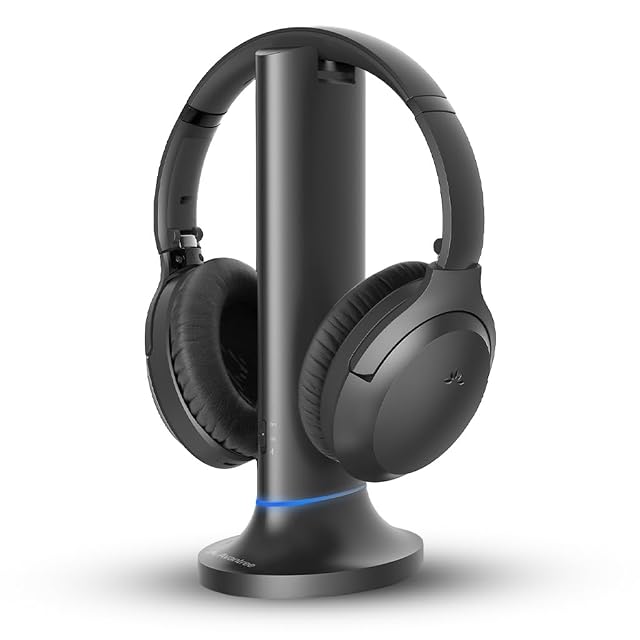
If your television is in that group, the products here that connect are the three Earbay listings (optical, RCA and AUX supplied together), the Holdsound and 1Mii transmitters, and the Avantree at $159.99 — four cents more than this — which is the only one with HDMI ARC.
Four country adapters
EU, UK, US, AUS.
The only international power provision on the shelf, which also says something about the product: it is sold worldwide rather than built for one market.
For anyone who travels with it, or buys it in one country for a relative in another, that is a practical detail nobody else here offers.
What is not published
No latency figure, where five cheaper products publish under 40 ms.
No frequency response, and no signal-to-noise ratio — the RS 195 from the same maker is the only product on this shelf publishing a measurement: “Analog input: typ. 85 dBA at 1 Vrms, Digital input: > 90 dBA”.
No driver size, where the Sony RF400 publishes 1.57 inch units.
No usable weight, as above.
No optical input.
And no volume limit, on a product with a speech profile sold for hearing dialogue. Only the Avantree at $159.99 addresses that subject anywhere on this shelf, by stating what it will not do: “not for users with severe hearing loss or those needing hearing-aid-level amplification”.
Availability
At the check, the American Amazon store stood at roughly $160.
These numbers are what Keepa carried on the day this page was last built. Stock and prices move without notice.
Prices quoted in this text were read on 4 October 2026. The live price is at the top of the page.