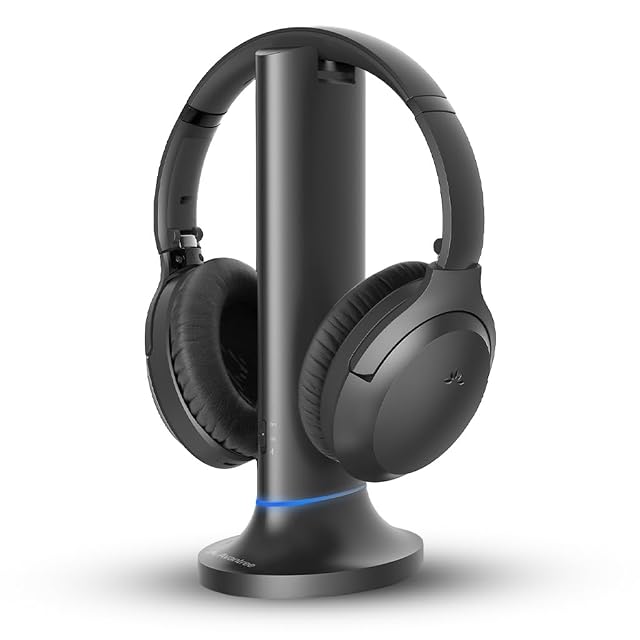
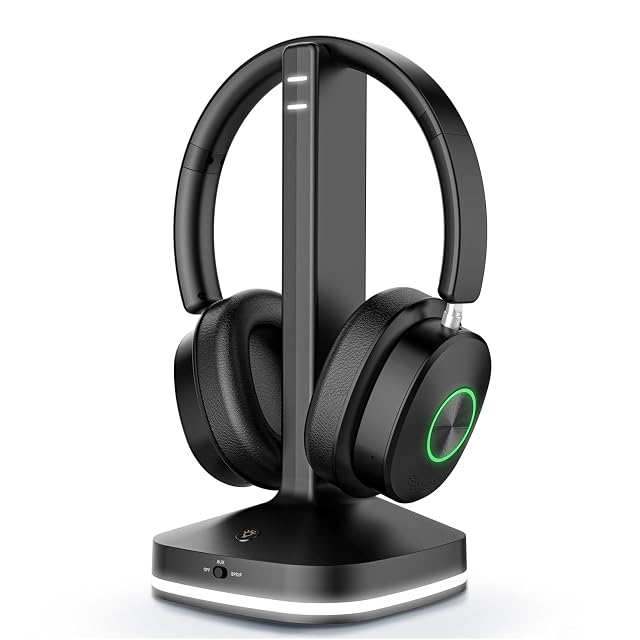
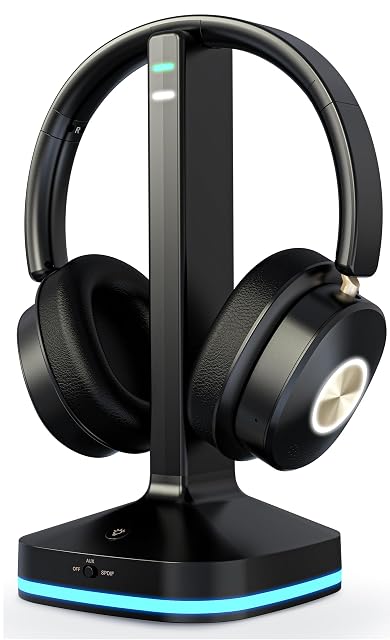
What the maker puts in writing
- “Ultra 2.4G Low Latency” with “less than 40ms”
- “up to 75 hours” of playtime
- “3 EQ Modes - TV, Movie, and Music”
- “In bypass mode, the audio output connects not only to soundbars and wired speakers but also to another ClearlinkTV H3. This easily supports multi-user scenarios like home movie viewing or silent parties, allowing everyone to adjust their volume independently”
- “Bluetooth 6.0”
- “up to 100ft” · charging dock
The bypass mode, which solves two problems nothing else here solves
“connects not only to soundbars and wired speakers but also to another ClearlinkTV H3… allowing everyone to adjust their volume independently.”
Problem one: the single optical port. A television has one optical output. Plug a headphone transmitter into it and the soundbar goes quiet; plug the soundbar back in and the headphones go quiet. Bypass passes the signal through, so both play.
The Avantree at $159.99 is the only other listing here that addresses this, and it is specific about the limits: optical passthrough works, while “HDMI soundbar passthrough is NOT supported”. It also warns, correctly, to “check whether it is already in use before purchasing” — the obstacle nobody else mentions.
Problem two, and this is the original one: two listeners. The commonest complaint about television headphones is that they are antisocial. One person needs the dialogue loud, the other does not, and the solution every other product here offers is that one person wears headphones and the other gets nothing.
Chaining a second ClearLinkTV H3 gives two people headphones with separate volume controls. That is a real answer, and no other product on this shelf has one.
Seventy-five hours, by a margin of thirty-five
The longest battery figure here, and not by a little:
1Mii — 75 h
Earbay ×3, Holdsound — 40 h
Sony RF400 ×3, Sennheiser RS 120-W — 20 h
Sennheiser RS 175, RS 195 — nothing published
No conditions are stated — no volume, no mode, no codec — so it is a best case, like every battery figure on every listing.
And in daily use it matters less than it appears, because this has a charging dock: the headphones live on the transmitter between sessions, so they are charged whenever they are not being worn. The Holdsound and all three Earbay listings do the same.
Where a long figure does count: a long film, a power cut, and the fifth year. A cell that started at seventy-five hours still has useful life when one that started at twenty does not.
Only the Sennheiser RS 120-W at $159.95 steps outside that logic, with replaceable AAA cells — “rechargeable AAA batteries”, published in its parts list as “1.2 V (AAA), NiMH”. It is the one product here that survives its own battery.
Three modes, and they are named
TV, Movie, Music.
Naming them is what makes the claim worth anything. A TV mode on this kind of product lifts the midrange where speech sits and trims the bass that masks it — which is the actual reason most people buy television headphones. A Movie mode widens the response for effects. Music flattens it.
What the rest of the shelf does:
Sennheiser RS 120-W, $159.95 — “Speech, Music, Neutral”
Sennheiser RS 195, $264.03 — Speech Mode, Music Mode
Sennheiser RS 175, $249.95 — Bass Boost, Surround Sound
Earbay, $59.99 — “3 Audio Modes”, named in no bullet
Two things fall out of that list. The $249.95 RS 175 has no speech mode — the most expensive but one on a shelf sold almost entirely on dialogue clarity. And a counted mode is not a checkable claim, where a named one is.
Under forty milliseconds, on a 2.4 GHz link
Forty milliseconds is roughly where the eye starts to catch that a voice does not match a mouth. Five listings here publish that threshold: this one, the Holdsound, and the three Earbay.
The reason it has to be stated is that ordinary Bluetooth is nowhere near: a standard A2DP connection on the SBC codec runs 150 to 250 ms, which on a face talking to camera is unwatchable.
This listing solves it with a dedicated 2.4 GHz transmitter rather than Bluetooth, which is the right approach — a proprietary link can run a low-latency protocol instead of a general-purpose one. Bluetooth 6.0 is offered alongside, for pairing a phone directly.
That 6.0 is the newest version claimed on this shelf — against 5.4 on the Earbay listings and 5.3 on the Holdsound. It is worth noting that the version number is not what controls latency; the codec is, and no listing here names one.
The three Sony RF400 listings publish no latency figure and have the least of anything here, because an analog RF link has no buffer to fill at all. They pay for it with a bullet reading “For Static sound issue, please refer the trouble shooting steps” — exactly what the Sennheiser RS 120-W targets with “Digital wireless transmission ensures no analog static.”
One hundred feet
Up to 100 ft — about thirty meters, which places this at the short end of the shelf:
Sennheiser RS 120-W 60 m · Holdsound 50 m (164 ft) · Sony RF400,150 ft (46 m) · 1Mii 100 ft · Earbay 30 m (100 ft)
Thirty meters keeps you in the room, more or less. Fifty lets you walk to the kitchen. Radio figures always describe open air, and walls cut them hard — but the ordering holds.
What is not published
No weight, where the Holdsound publishes 250 g and the Earbay at $59.99 publishes 255 g. On headphones worn through a film, weight is the comfort figure.
No driver size, where the Sony RF400 publishes 1.57 inch units.
No frequency response, and no signal-to-noise figure — the Sennheiser RS 195 is the only product on this shelf publishing a measurement: “Analog input: typ. 85 dBA at 1 Vrms, Digital input: > 90 dBA”, with the digital input 5 dB better.
The inputs are not fully enumerated. Bypass mode implies an output, and a transmitter implies optical or RCA or a jack, but the bullets do not list them the way all three Earbay listings do (“optical, RCA, and AUX”) or the way the Sennheiser RS 120-W publishes its complete parts list.
No codec, which is the thing that actually governs the latency claim.
And the battery is sealed. Seventy-five hours is the best figure here; it is still a cell that cannot be changed.
Availability
At the check, the American Amazon store stood at roughly $90.
These numbers are what Keepa carried on the day this page was last built. Stock and prices move without notice.
Prices quoted in this text were read on 4 October 2026. The live price is at the top of the page.