Skip to content

Earbay JLS-TV966CD review

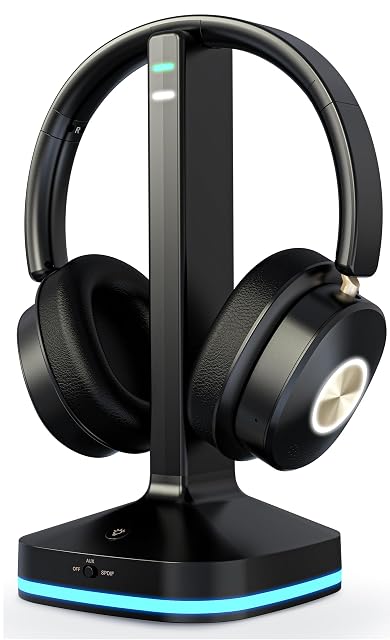
The third Earbay: same model, 255 g (9 oz) published, and three audio modes named only in the title.

The closing call Seven dollars above the two identical Earbay listings, for a title that claims three audio modes no bullet describes — and a published weight of 255 grams, which is the real gain.

What the maker puts in writing

  • “Bluetooth 5.4… keeps sound perfectly in sync with the picture, with latency below 40ms”
  • “up to 30 meters (98 ft) (100 feet)”
  • “up to 40 hours” with a “charging base”
  • “optical, AUX, and RCA” inputs on the transmitter
  • “protein leather earpads” with “memory foam”
  • Title: “3 Audio Modes”
  • Catalog weight: 255 g (9 oz) · Reference: JLS-TV966CD-B-NEW-3

Two hundred and fifty-five grams, which is the real difference

This is the only Earbay listing here that publishes a weight, and on a product worn through a film that is the figure that decides everything.

What the shelf publishes:

Holdsound 250 g · this 255 g · Sony RF400,277 g · Sennheiser RS 175,310 g · Sennheiser RS 195,454 g — exactly 1.00 lb.

Two figures here are not headphone weights at all. The Sony RF400 Renewed publishes 1361 g (48 oz) — exactly 3.00 lb — where the identical new listing publishes 277 g (9.8 oz), so the renewed figure is the packed set. And the Sennheiser RS 120-W publishes 695 g (24.5 oz), which for headphones described as “lightweight on-ear” can only be the box with its transmitter and country adapters.

Both $52.99 Earbay listings publish nothing. That is what the seven dollars actually buys: a number.

One caveat — this is over-ear, surrounding the ear. The RS 120-W is the only on-ear product here: it rests on the ear instead, which runs cooler over a long session and isolates less.

Three audio modes, named nowhere

The title claims “3 Audio Modes”. No bullet names them. Not what the three are, not what each changes, not how to switch.

That phrase is the other half of the seven-dollar gap, against two listings from the same maker sharing the same base reference 966 and the same published figures throughout.

What naming them looks like, on this shelf:

Sennheiser RS 120-W, $159.95 — “Three listening profiles - Speech, Music, Neutral” 1Mii, $89.99 — “3 EQ Modes - TV, Movie, and Music” Sennheiser RS 195, $264.03 — Speech Mode, Music Mode Sennheiser RS 175, $249.95 — Bass Boost, Surround Sound

A named mode is a claim you can check. A counted one is not.

And the comparison exposes something about the shelf: the RS 175 at $249.95 is the most expensive product here with no speech mode at all, on a shelf sold almost entirely on dialogue clarity.

“No-delay”, and what the bullet actually says

The title says no-delay. The bullet says “below 40ms”, which is the honest version.

Forty milliseconds is a real figure and a good one — roughly the threshold where the eye catches a voice not matching a mouth. It is why five listings here publish it: the three Earbay, the 1Mii, the Holdsound.

It is not zero. The products with the least delay are the three publishing no figure at all: the Sony RF400 at $91.88, $138 and $189.99, whose analog RF link has no buffer to fill.

The Sony pays for it elsewhere. One of its own bullets reads “For Static sound issue, please refer the trouble shooting steps”, and its description tells you to buy a different model if your television is modern. The Sennheiser RS 120-W aims directly at that weakness: “Digital wireless transmission ensures no analog static.”

Protein leather over memory foam

Two materials, two jobs.

Protein leather is a synthetic that is softer and more breathable than ordinary PU, and does not crack like vinyl. Memory foam takes the shape of the head over a few minutes, spreading clamp pressure instead of concentrating it on two points.

On a product whose job is a three-hour film, that combination does more for the experience than any driver specification — and it is published by the Holdsound, the 1Mii and both other Earbay listings.

Three cables, and the one that is missing

Optical, AUX and RCA on the transmitter covers every television era: RCA and the headphone jack for older sets, optical for newer ones.

Which is worth having, because the Sony RF400 at $138 says this in its own description: “designed for older televisions with Stereo Audio connectors or a headphone jack: newer televisions with HDMI or Digital Optical should instead use headphone model WH-L600.”

What is absent is HDMI ARC, and only the Avantree at $159.99 has it here.

There is also a question none of the three Earbay listings addresses: a television has one optical output, and if a soundbar occupies it, nothing is left. The Avantree warns about exactly that — “check whether it is already in use before purchasing” — and offers optical passthrough. The 1Mii offers a bypass mode that keeps the soundbar playing.

What is not published

No driver size, where the Sony RF400 publishes 1.57 inch units.

No frequency response, and no signal-to-noise figure. The Sennheiser RS 195 at $264.03 is the only product on this shelf publishing a measurement: “Analog input: typ. 85 dBA at 1 Vrms, Digital input: > 90 dBA” — with the digital input 5 dB better than the analog.

No volume limit, on a product sold for amplified dialogue.

And a sealed battery, as on ten of the twelve products here. Only the Sennheiser RS 120-W uses cells you can replace — “rechargeable AAA batteries”, named in its parts list as “1.2 V (AAA), NiMH”. It is the one product here that outlives its own battery.

Availability

At the check, the American Amazon store stood at roughly $60.

These numbers are what Keepa carried on the day this page was last built. Stock and prices move without notice.

Prices quoted in this text were read on 4 October 2026. The live price is at the top of the page.
In its favor, and against it

Strengths

  • Publishes 255 g (9 oz), which neither $52.99 Earbay does — and weight is the comfort figure
  • Below forty milliseconds, with all three cables supplied
  • Two hundred and fifty-five grams is the second lightest figure on the shelf

Compromises

  • Three audio modes in the title, named and described in no bullet
  • Seven dollars above two identical listings from the same maker
  • No driver size and no frequency response published

Specifications

Weight255 g (9 oz) — the only Earbay listing here that publishes one
LatencyBelow 40 ms
WirelessBluetooth 5.4
RangeUp to 30 m (100 ft)
BatteryUp to 40 hours per charge
Sound modesThree, claimed in the TITLE and described in no bullet
TransmitterCharging base with optical, AUX and RCA inputs
EarpadsProtein leather with memory foam
FitOver-ear
ReferenceJLS-TV966CD-B-NEW-3 — the same 966 as both $52.99 listings
Driver sizeNot published
Frequency responseNot published
What the three modes areNot published
Amazon referenceB0H5J2HHPK
EAN0735530714591

What gets asked most

What are the three audio modes?

The listing does not say. The title claims "3 Audio Modes" and no bullet names them, describes what each changes, or explains how to switch. That is the whole of the seven-dollar difference against this maker’s two other listings here, which share the same base reference 966 and publish the same Bluetooth 5.4, under 40 ms, 30 m (98 ft), 40 hours and protein leather with memory foam. Compare what naming them looks like. The Sennheiser RS 120-W at $159.95 publishes "Three listening profiles - Speech, Music, Neutral". The 1Mii at $89.99 publishes "3 EQ Modes - TV, Movie, and Music". The Sennheiser RS 195 at $264.03 publishes Speech Mode and Music Mode, and the RS 175 at $249.95 publishes Bass Boost and Surround Sound. A named mode is a checkable claim; a counted one is not.

Is 255 grams light for television headphones?

It is near the light end of what this shelf publishes, and it is the reason to prefer this listing over its twins. Published weights: Holdsound 250 g (8.8 oz), this 255 g (9 oz), Sony RF400,277 g (9.8 oz), Sennheiser RS 175,310 g (6183.9 oz), Sennheiser RS 195,454 g (6894.4 oz) — exactly 1.00 lb. Two figures on this shelf are not headphone weights at all: the Sony RF400 Renewed at 1361 g (48 oz) (3.00 lb — the packed set, since the identical new listing publishes 277 g) and the Sennheiser RS 120-W at 695 g (24.5 oz), which for on-ear headphones can only be the box with transmitter and adapters. Weight is the figure that decides whether a two-hour film is comfortable, and it is the figure most often left out — including by both other Earbay listings. There is one caveat: this is over-ear, which surrounds the ear. The Sennheiser RS 120-W is the only on-ear product here, which runs cooler over a long session and isolates less.

Does "no-delay" in the title mean no delay?

No, and the bullet is the honest version: "below 40ms". Forty milliseconds is a real figure and a good one — it is roughly the threshold where the eye starts to catch a voice not matching a mouth, which is why five listings here publish it. But it is not zero. The products on this shelf with the least delay are the three that publish no figure: the Sony RF400 at $91.88, $138 and $189.99 use analog RF, which has no buffer to fill and therefore nothing to delay. The Sony carries a different cost for it — a puce reading "For Static sound issue, please refer the trouble shooting steps", and a description telling you to buy a different model if your television is modern. The Sennheiser RS 120-W aims straight at that: "Digital wireless transmission ensures no analog static."

Against the home cinema devices in the same bracket

Between home cinema devices of the same category and nearby price. Shown: what they all state. A half-filled column says nothing.

Model Price WeightLatencyRangeBattery
Earbay JLS-TV966CD $60 255 g (9 oz) — the only Earbay listing here that publishes oneBelow 40 msUp to 30 m (100 ft)Up to 40 hours per charge
Earbay KS-TV-966H2-CD $53 Not publishedUnder 40 msUp to 30 m (100 ft)Up to 40 hours per charge — and the title does not contradict it
Earbay KS-TV966CD $53 Not publishedUnder 40 ms — see the FAQ on why that figure mattersUp to 30 m (100 ft)Up to 40 hours per charge — the TITLE says 45, see the FAQ
1Mii ClearLinkTV H3 $90 Not publishedLess than 40 ms, on an ultra low latency 2.4 GHz linkUp to 100 ftUp to 75 hours of playtime — the longest on this shelf by 35 hours

What the models do not share, in home cinema devices

  • If price decides: Earbay KS-TV-966H2-CD, at $53.
  • Highest Battery in the table: 1Mii ClearLinkTV H3 (Up to 75 hours of playtime — the longest on this shelf by 35 hours).

Who should pick this one, among home cinema devices

Long viewing sessions, where 255 grams is the figure that decides comfort

What buyers actually choose

Amazon reports what buyers took in the month before this page was last checked: at least 200.

The figure is a floor, rounded by Amazon, and read through Keepa — it says what buyers picked, not what a maker claims.

Sources

Specifications: the manufacturer sheet for home cinema gear and the matching Amazon product page. Prices and availability: Keepa. Every figure on this page names its source.

The method applied to these home cinema devices