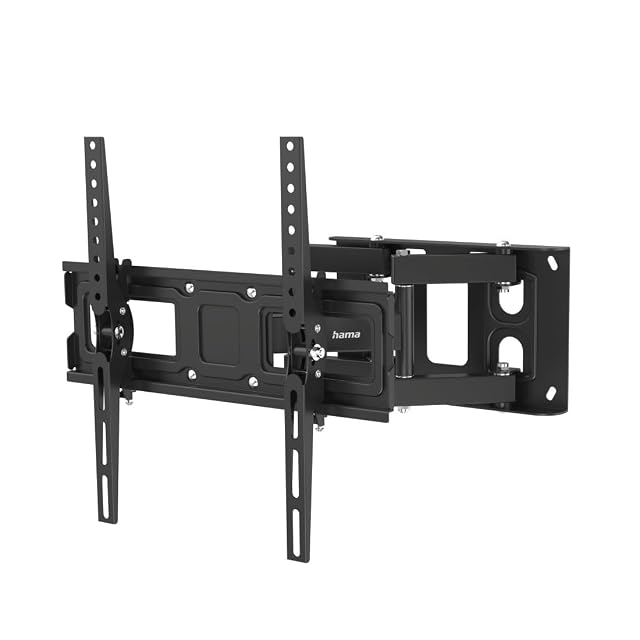
The bottom line The clearest statement here about walls — with the extension figure, which matters just as much, left out.
The unusual disclosure
It names its wall types: concrete, brick and wood stud (single stud). Almost every mount states a load and stops. Naming the construction the mount was designed for tells you something the load figure cannot, and it is the more useful of the two.
What “single stud” fixes
The position. A single-stud mount has to be centred on a stud, and studs sit at fixed intervals in a timber wall. The television goes where the stud is, not where the room would prefer.
The movement
+10° to −5°, plus swivel. Fifteen degrees of tilt is enough for a set mounted above a fireplace, which is where tilt earns its place.
What is not published
The maximum extension. On an arm, that figure decides how much turning moment reaches the fixings, and it is absent here. A mount that extends 200 mm and one that extends 400 mm make very different demands on the same wall with the same television.
The size limits
55 inches, 36.3 kg. Comfortable for a bedroom or a second room, modest for a main set today.
Availability
On sale from 16 € to 20 € on the German, American, British, French, Italian and Spanish Amazon stores at the time of checking.
The Spanish Amazon listing is priced above 1.6× the cheapest store, which is normally a reshipping offer rather than a local price; it is left out of the range above.
Prices and availability are what Keepa reported on the date this page was updated; both move.
Prices quoted in this text were read on 4 September 2026. The live price is at the top of the page.
What we like, and what we don't
Strengths
Names the wall types it was designed for, which almost no listing does
A useful tilt range of fifteen degrees in total
VESA to 400×400 within a 55-inch size range, which is a comfortable margin
Compromises
Maximum extension is not stated, and on an arm it is the figure that decides the demand on the wall
A single-stud design limits where on a timber wall it can go
55 inches is modest for a living-room set today
Specifications
Screen size
26–55 inches (66–140 cm) — stated
VESA range
100×100 mm to 400×400 mm — stated
Stated load capacity
36.3 kg — the mount, not the wall
Tilt
+10° to −5° — stated
Wall types stated
Concrete, brick and wood stud (single stud) — stated by the maker
Movement
Swivelling and tilting — stated
Amazon reference
B01KBEOL5E (same reference on 6 Amazon marketplaces)
EAN
0841710153613
Questions people actually ask
Why does "single stud" matter?
Because a mount designed for one stud must be centred on that stud, and studs are typically spaced 40 or 60 cm apart. That fixes where on the wall the television can go, which is a planning constraint rather than a specification one.
What is missing from the specification?
The maximum extension. On an articulating mount, the distance the screen sits from the wall is what determines the turning moment on the anchors, and this listing does not publish it.
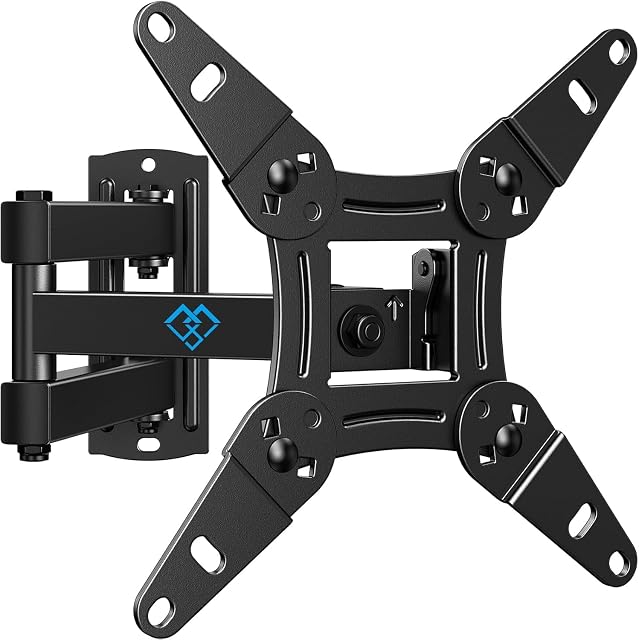
32–75" (81–191 cm) · VESA up to 400×400 · swivel up to 160° · tilt 15° · extendable · drilling template, spirit level and fischer plugs supplied · developed in Germany
A full-motion mount that arrives with a drilling template, a spirit level and named fischer plugs — the installation kit is the argument.
Best for: A first wall-mount installation, where having the right template and plugs in the box removes a trip to a shop.
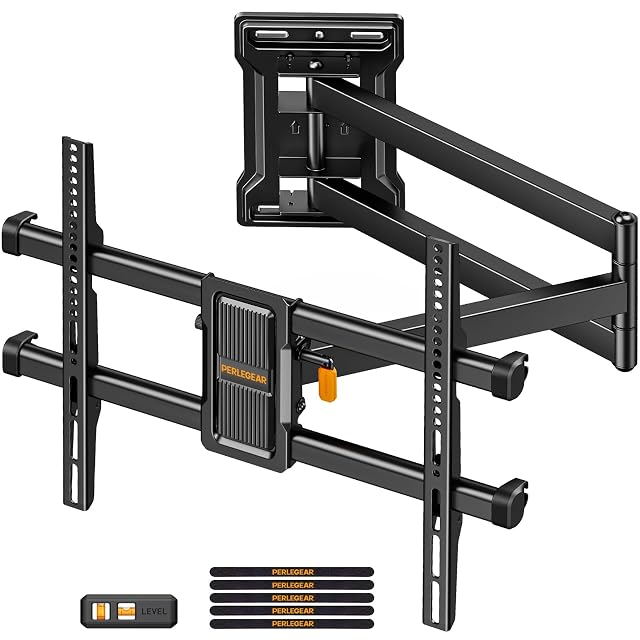
32–65" (81–165 cm) · VESA from 200×100 to 200×200 and wider · 60 kg stated load · tilt −15° to +5°, two adjusters · swivel ±90° · single-joint arm, 30% thicker
A stated 60 kg on a single arm with two separate tilt adjusters — the heaviest capacity on this shelf outside the premium bracket.
Best for: A heavy mid-to-large set that needs to swing out, on a wall that has been properly identified.