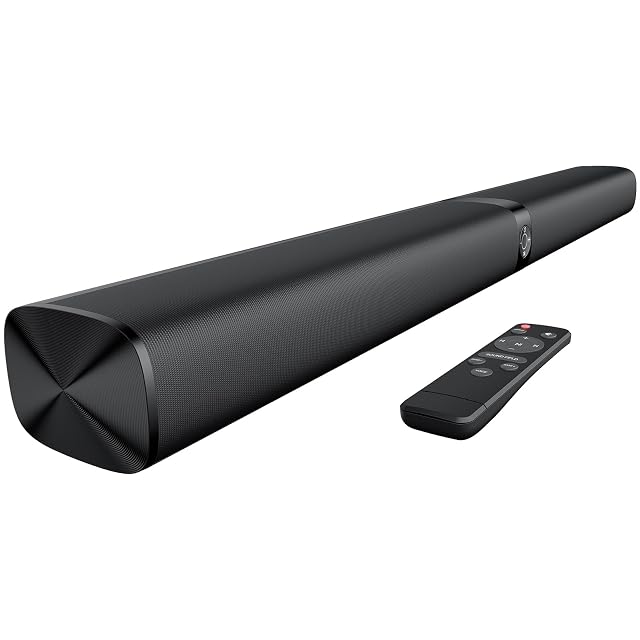
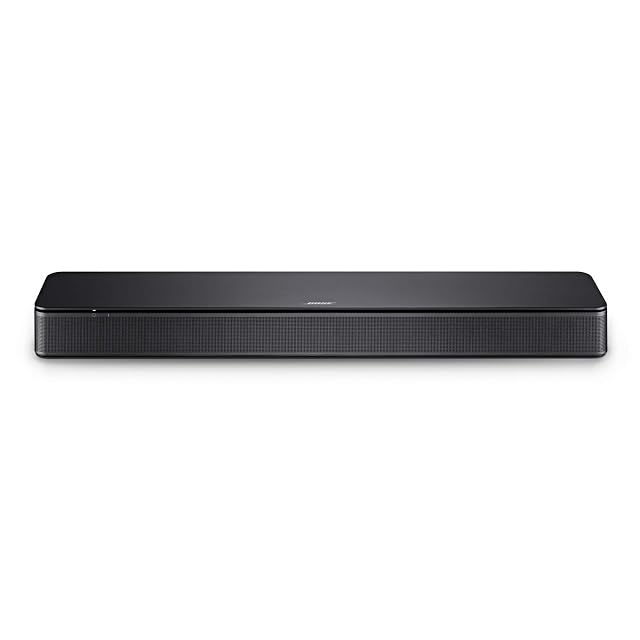
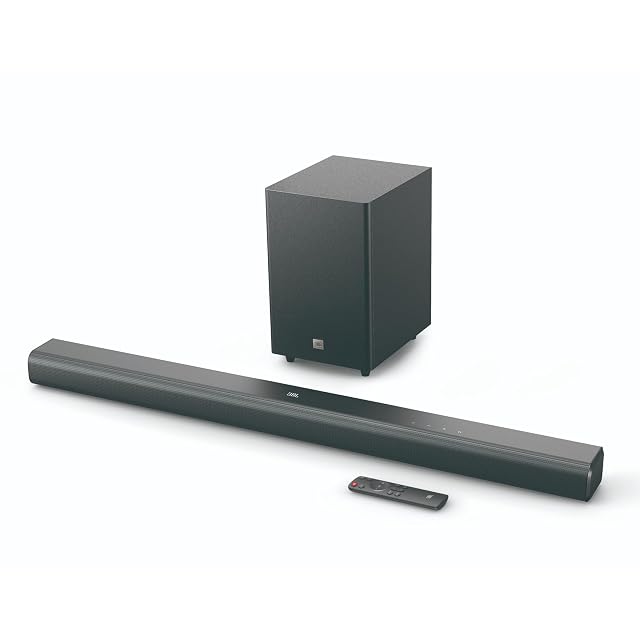
The bottom line The honest cheap bar: two channels, a voice mode that addresses the real complaint, and a power figure labelled as the maximum it is.
What it fixes
The television’s own speakers, which fire backwards or downwards into furniture. Almost any bar improves on that, and this one adds a voice enhancement mode that lifts speech relative to the rest — which is the specific complaint most households have.
What 2.0 means
Two channels, no centre, no subwoofer. Dialogue is reproduced as a phantom image between the two drivers: it works from the middle seat and drifts as you move. A 3.1 bar solves that physically; this one addresses it with processing.
The power figure, read properly
120 W maximum audio power. The word “maximum” is doing the work. An RMS rating states what the amplifier sustains, under stated conditions; a maximum states a peak. Neither is dishonest, and only one is comparable to another brand’s number.
What DTS Virtual:X does
Processes a soundtrack to suggest height and width from two drivers. It is a real effect and it is not surround: nothing arrives from behind or above, because nothing is there.
Where the money goes next
A bar with a centre channel, if dialogue remains the complaint. That, rather than more power, is the upgrade that changes it.
Availability
On sale from 45 € to 62 € on the German, British, French, Italian and Spanish Amazon stores at the time of checking.
The French and Italian Amazon listings are priced above 1.6× the cheapest store, which is normally a reshipping offer rather than a local price; they are left out of the range above.
Not found on the American Amazon store, where the buy link falls back to a local search rather than to a page that does not exist.
Prices and availability are what Keepa reported on the date this page was updated; both move.
Prices quoted in this text were read on 4 September 2026. The live price is at the top of the page.
What we like, and what we don't
Strengths
A voice enhancement mode, which addresses the dialogue problem without a centre channel
Decodes Dolby Audio and DTS Virtual:X, a fuller format list than the price suggests
Two channels and nothing else to place — the simplest possible upgrade over television speakers
Compromises
2.0 means no centre channel: dialogue is a phantom image between the drivers
"120 W max" is a maximum rather than a measured continuous rating, and the two are not comparable
No subwoofer, so the low end is limited by the bar's own cabinet
Specifications
Channels
2.0 — stated; no centre channel and no subwoofer
Power
120 W maximum audio power — stated as a maximum, not as RMS
Formats
Dolby Audio, DTS Virtual:X — stated
Speech
Voice Enhanced mode — stated
Modes
TV Mode, EzPlay — stated
Amazon reference
B0FJ8K3YVT (same reference on 5 Amazon marketplaces)
EAN
6942351422640
Questions people actually ask
What does "120 W max" actually mean?
A maximum rather than a continuous measurement. An RMS figure states power the amplifier can sustain, with the load, the bandwidth and the distortion it was measured at; a "max" figure states none of those. Both are real numbers describing different things, and only the first compares across brands.
Can voice enhancement replace a centre channel?
Partly. It raises the frequency range where speech sits relative to everything else, which helps. A physical centre speaker places the dialogue at the screen for every seat, which processing cannot do.
A deliberately small bar sold on how it behaves rather than on published figures — which is a real approach and one this page reports rather than fills in.
Best for: A small room where the bar has to be unobtrusive, and a buyer who prefers a known result to a comparable specification.