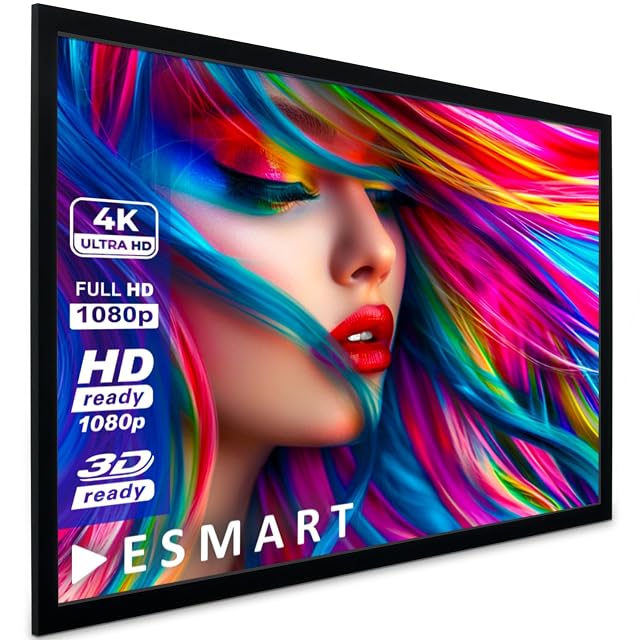
The bottom line The construction that removes the one variable a projector cannot correct — bought at the entry price, with the specification sheet of an entry product.
What a fixed frame is for
Flatness. A projected image reveals every ripple in its surface, and a tensioned fabric on a rigid frame is the only construction in this catalogue with none. On a long-throw machine the difference is modest; with a short-throw projector, where light arrives at a steep angle, it is the difference between a picture and a picture with bands in it.
The black border
Standard on this construction and worth understanding: it absorbs the overspill at the edge of the image and gives the eye a reference. That is why fixed-frame screens look sharper than the same fabric hanging loose, with nothing else changed.
What this listing does not publish
Gain, and black backing. Gain says how much light returns toward the viewer — 1.0 is neutral, and higher concentrates it toward the centre at the cost of viewing angle. Backing is the opaque layer that stops light passing through and coming back. Neither is stated here, and this page will not assume values for them.
Sizing it
The listing gives 200 × 113 cm of image and a 90-inch diagonal. Measure the wall between whatever is fixed — a window, a beam — before ordering, and remember that the frame adds to the image dimensions.
Where it sits
The entry price for the construction. What you are buying is the frame and the tension; the fabric specification is where a more expensive screen puts its money.
Availability
On sale at around 150 € on the German, French and Spanish Amazon stores at the time of checking.
The French and Spanish Amazon listings are priced above 1.6× the cheapest store, which is normally a reshipping offer rather than a local price; they are left out of the range above.
Listed but with no offer on the American, British and Italian Amazon stores — the reference exists there and nobody is currently selling it.
Prices and availability are what Keepa reported on the date this page was updated; both move.
Prices quoted in this text were read on 4 September 2026. The live price is at the top of the page.
What we like, and what we don't
Strengths
A tensioned fabric on a rigid frame is permanently flat — the one thing a roller screen cannot promise
A fixed frame comes with a black border, which absorbs edge overspill and visibly sharpens the image
celexon publishes image dimensions in centimetres as well as a diagonal, which is what you actually measure against a wall
Compromises
No gain figure published, so its behaviour with a high-gain or ambient-light-rejecting requirement cannot be assessed
No black backing stated — the layer that stops light passing through and returning
A fixed frame occupies the wall permanently, which is the whole trade against a roller screen
Specifications
Image size
200 × 113 cm, 90 inch diagonal — stated
Format
16:9 — stated
Construction
Fixed frame, tensioned fabric — stated
Gain
Not published in this listing
Backing
Not published in this listing
Amazon reference
B01N9EYZYJ (same reference on 6 Amazon marketplaces)
EAN
4260094737077
Questions people actually ask
Is a fixed frame really flatter than a good roller screen?
Yes, and it is inherent rather than a matter of quality. Fabric that has been rolled keeps some memory of it; fabric tensioned on a frame does not. A tab-tensioned roller screen closes most of the gap and does not eliminate it.
Why does the border matter?
It absorbs the light that spills just outside the image and gives the eye a hard edge to reference. The effect is that the picture looks sharper and its blacks look deeper, and it is the cheapest visible improvement in a projected system.
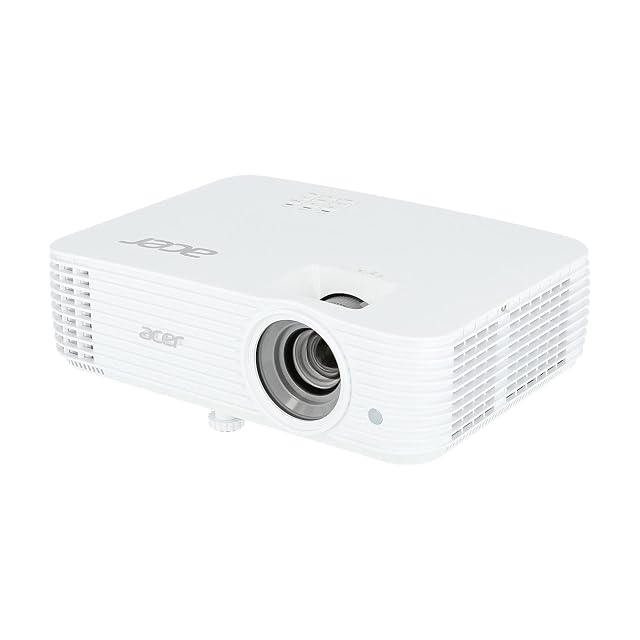
A 4K UHD DLP projector that states its brightness in ANSI lumens at a price where most of the shelf stops doing so — and a specification sheet that reads like a data table rather than a sales page.
Best for: A first 4K projector in a room where the light can be controlled and the machine can sit where the throw ratio wants it.