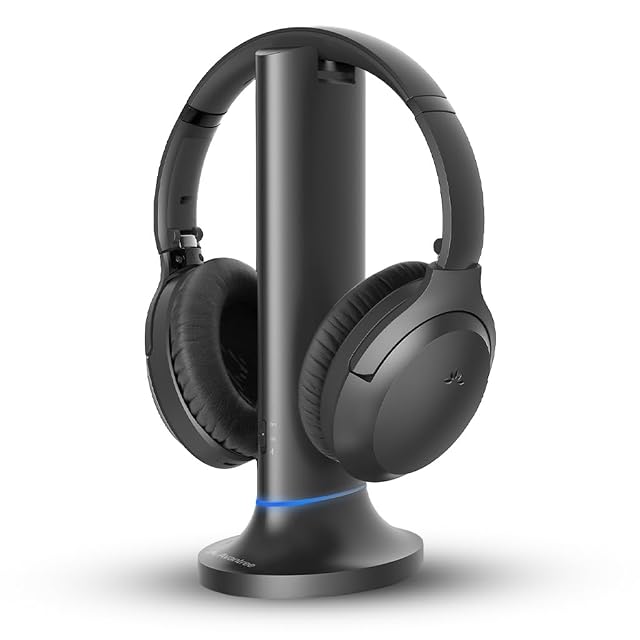
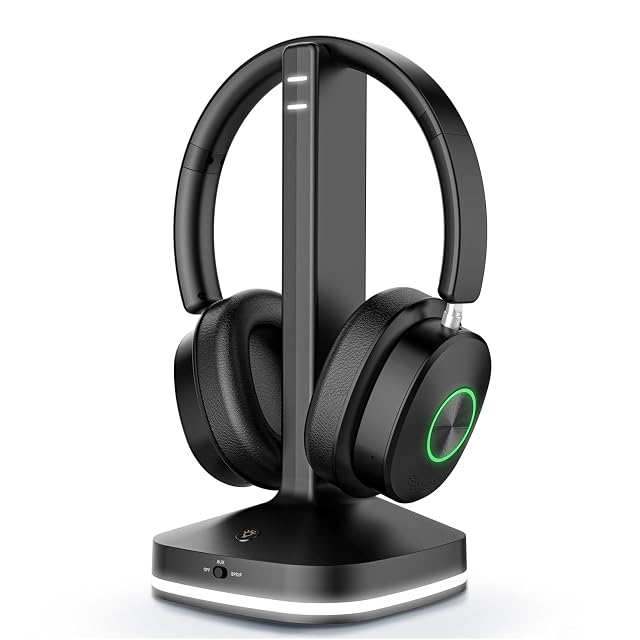
What the maker puts in writing
- “Over-ear Digital Wireless Headphones with Bass Boost Surround Sound Modes”
- Catalog weight: 310 g (10.9 oz)
That is the bullet. One line, and everything else is in the description.
Bass boost and surround, on a shelf about dialogue
The two modes this listing names are bass boost and surround sound.
Neither is a speech mode, and that is the striking fact about the second most expensive product here.
What the rest of the shelf publishes:
Sennheiser RS 195, $264.03 — Speech Mode, Music Mode
Sennheiser RS 120-W, $159.95 — “Three listening profiles - Speech, Music, Neutral”
1Mii, $89.99 — TV, Movie, Music
Sony RF400 ×3 — Voice Mode
Sennheiser RS 175, here, $249.95 — Bass Boost, Surround Sound
This matters because of what the modes do. A speech setting lifts the midrange where voices sit, and trims the bass that masks them. Bass boost does the reverse — and bass is what buries dialogue in the first place.
Almost every listing on this shelf is sold on the same promise: hearing what people are saying without turning the television up for everyone else. The Avantree writes it most clearly — “viewers who struggle to hear TV dialogue… without increasing the TV volume for others”.
If that is the reason for buying, this listing’s own stated modes point away from it.
What surround is good for is different and real: film soundtracks, effects, a sense of space from two drivers. Only this product offers it here.
Ninety dollars above its own cheaper sibling, with less published
The comparison that decides this listing is with the Sennheiser RS 120-W at $159.95 from the same maker.
What the RS 120-W publishes and this does not:
Up to 60 m of range, second on this shelf only to the RS 175’s European listing.
Up to 20 hours of playback.
Three listening profiles, including speech.
A complete parts list: “Headphones HDR 120-W, Transmitter TR 120-W with stereo RCA audio cable, Mains unit with country adapters (EU, UK, US, AUS), Two rechargeable batteries: 1.2 V (AAA), NiMH, Adapter for audio connection 3.5 mm (0.14 in)”.
Replaceable batteries — the only ones on this entire shelf.
What this publishes and the RS 120-W does not:
Surround sound and bass boost processing.
An over-ear fit rather than on-ear.
A weight of 310 g (10.9 oz).
Over-ear against on-ear is a genuine preference, not a ranking: over-ear encloses the ear and isolates more, on-ear rests on it and runs cooler over a long film.
But as documentation, the cheaper Sennheiser is a specification and this is a sentence.
The replaceable battery, which this listing does not have
The RS 120-W publishes “Two rechargeable batteries: 1.2 V (AAA), NiMH”, and it is the only product on this shelf that does.
That is what decides how long a pair of wireless headphones lasts. A sealed lithium cell loses capacity with every cycle and with age whether used or not. After three to five years it runs for a fraction of its original time, then lives on the charger, then the product is finished — working drivers, working radio, dead battery, no way in.
With AAA NiMH cells you buy two for a few dollars and carry on.
On a $249.95 product, the absence of that information is the thing most worth asking about before buying — because this is the price at which you expect to keep something.
Digital, which is a genuine advantage
A digital link is the right side of the central division on this shelf.
Three of the twelve listings here are the Sony RF400 on analog RF, and one of Sony’s own bullets reads: “For Static sound issue, please refer the ‘trouble shooting steps’.” Analog radio degrades like FM radio — gradually, into hiss, as the signal weakens or something interferes.
A digital link holds cleanly and then drops out. The RS 120-W states the claim directly: “Digital wireless transmission ensures no analog static.”
What the analog Sonys get in exchange, and never advertise, is no buffer and therefore essentially no latency — which is why they publish no millisecond figure while five cheaper products publish “under 40 ms”.
This listing publishes no latency figure either, and on a digital product that is a gap: a digital link has to buffer and decode, so there is a real number, and Sennheiser’s proprietary systems are normally good at it.
Three hundred and ten grams
Published, which four listings on this shelf do not manage.
Holdsound 250 g · Earbay 255 g · Sony RF400,277 g · RS 175,310 g · RS 195,454 g (exactly 1.00 lb).
Two figures here are not headphone weights: the Sony RF400 Renewed at 1361 g (48 oz) — exactly 3.00 lb, against 277 g (9.8 oz) on the identical new listing — and the RS 120-W at 695 g (24.5 oz), which for headphones its own text calls lightweight on-ear can only be the packed box.
At 310 g (10.9 oz) this is on the heavier side of what is wearable, which is normal for over-ear with a full-size battery and a digital receiver. Weight is the figure that decides whether a three-hour film is comfortable.
What is not published
No range. No battery life. No latency figure. No frequency response. No driver size. No inputs enumerated — not optical, not RCA, not a jack. No codec. No volume limit.
And no signal-to-noise ratio, which the RS 195 directly above it does publish: “Analog input: typ. 85 dBA at 1 Vrms, Digital input: > 90 dBA” — the only measurement anywhere on this shelf, with the digital input 5 dB better than the analog.
For $249.95, that is a short list of things known and a long list of things not.
Availability
At the check, the American Amazon store stood at roughly $250.
These numbers are what Keepa carried on the day this page was last built. Stock and prices move without notice.
Prices quoted in this text were read on 4 October 2026. The live price is at the top of the page.