The bottom line A good speaker in a coherent range, sold here without the numbers that make Klipsch's case — those are on the maker's own sheet.
The range argument
Klipsch appears three times in this catalogue: this bookshelf pair, the R-121SW subwoofer and the R-40SA height modules. Bought together they form a system with shared voicing, and that coherence is the strongest reason to choose within one brand.
What horn loading does
It raises efficiency — more output for the same amplifier power — and narrows directivity. The first is useful anywhere; the second is useful in a small room, where less energy hitting the side walls means fewer early reflections muddying the image.
What this listing does not say
Sensitivity. It is the figure horn loading exists to raise, and it is Klipsch’s central technical argument. Its absence here is a property of the listing, and the maker publishes it elsewhere.
What to do with them
Stands, at ear height. A bookshelf speaker on an actual shelf is a compromise: the boundary reinforces bass unevenly and the tweeter ends up above or below the ears. Stands cost less than the difference between two tiers of speaker and matter more.
Crossing over
To a subwoofer, set at whatever the maker recommends. A compact cabinet is not a full-range speaker and treating it as one is what makes small speakers sound strained.
Availability
On sale from 278 € to 365 € on the German, British, French, Italian and Spanish Amazon stores at the time of checking.
Not found on the American Amazon store, where the buy link falls back to a local search rather than to a page that does not exist.
Prices and availability are what Keepa reported on the date this page was updated; both move.
Prices quoted in this text were read on 4 September 2026. The live price is at the top of the page.
What we like, and what we don't
Strengths
From a range that also supplies the R-121SW subwoofer and R-40SA height modules in this catalogue
Horn-loaded designs are generally efficient, which suits a modest amplifier
Passive, so amplifier and speaker age separately
Compromises
No sensitivity published, which is the brand's own central technical argument
No impedance and no frequency response published
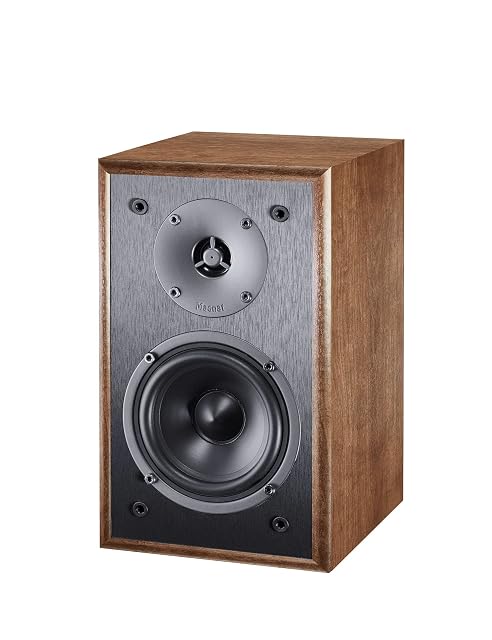
The listing describes appearance where a specification would be more useful
Specifications
Type
Passive, compact — stated
Range
Reference series — stated
Appearance
Slim modern design — stated
Sensitivity
Not stated in this listing
Impedance
Not stated in this listing
Amazon reference
B0DTYQV55B (same reference on 5 Amazon marketplaces)
EAN
0743878066845
Questions people actually ask
Why does this page not give the sensitivity?
Because this listing does not publish it. Klipsch generally quotes high sensitivity as its main technical claim, and its absence here is a fact about the listing rather than about the speaker. The maker's own specification sheet will carry it.
Does horn loading suit a small room?
It is efficient, which means it plays loud on modest power — useful with a receiver's weaker channels. Its directivity is also narrower, which in a small room can be an advantage: less energy reaching the side walls means fewer early reflections.
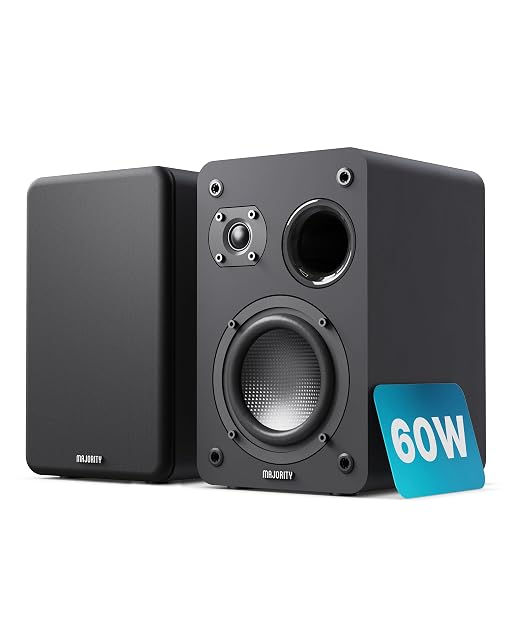
2-way · 60 W RMS (120 W peak) · 4–8 Ω · 88 dB sensitivity · 110 mm woofer-mid, 13 mm tweeter
The only bookshelf speaker in this catalogue that publishes RMS power, impedance range AND sensitivity — the three figures that decide whether an amplifier suits it.
Best for: Anyone matching speakers to an amplifier on published figures rather than on brand.