Native panel, pixel shift, or upscaling — three different things · review
BenQ TK705i 4K HDR projector with Google TV review
A 4K HDR projector with Google TV on board and a stated 3 000 ANSI lumens — the built-in system is the reason to choose it, and the reason to check licensing before buying.
The bottom line The self-contained 4K option: bright enough to be stated in ANSI, complete enough to need nothing else plugged into it, and dependent on a software layer whose future is a licensing question.
What you are getting
A 4K projector with HDR support and Google TV built in, rated at 3 000 ANSI lumens. It is a complete source and display in one chassis.
Why the built-in system is the decision
A projector with an operating system is bought as an appliance. That removes a box, a cable and a remote — and it makes the machine’s usefulness partly a licensing question. Which services are available, and at what resolution, is decided by agreements between the manufacturer and the platforms, and it changes with firmware. Check the services you actually subscribe to, by name, on the maker’s own page.
The brightness figure, and why it is worth trusting
3 000 ANSI lumens. ANSI is measured to a defined procedure, which is what makes one figure comparable to another. On this shelf, machines quoting unqualified “lumens” cannot be compared to this one at all — there is no conversion between the two, because one of them is not a measurement.
What the listing does not give you
A native contrast ratio, and a throw ratio. The second is the one to chase down before buying: throw ratio multiplied by image width gives the distance the machine needs, and that arithmetic decides whether it fits your room long before any picture specification does.
The range it comes from
BenQ splits home cinema and gaming explicitly rather than badging one machine as both. A model tuned for input lag and refresh rate is a different product from one tuned for contrast and colour, and knowing which you are looking at is half of choosing well here.
Availability
On sale from 1225 € to 1349 € on the German, British, French, Italian and Spanish Amazon stores at the time of checking.
Not found on the American Amazon store, where the buy link falls back to a local search rather than to a page that does not exist.
Prices and availability are what Keepa reported on the date this page was updated; both move.
Prices quoted in this text were read on 4 September 2026. The live price is at the top of the page.
What we like, and what we don't
Strengths
Brightness stated in ANSI lumens, which makes it comparable to any other machine that does the same
Google TV on board removes the need for a separate streaming box and a second remote
BenQ separates its home cinema and gaming ranges explicitly, so the model name tells you what it was tuned for
Compromises
The built-in system is the part that ages, and which services run at full resolution is a licensing question that changes with firmware
The maker does not publish a native contrast figure in this listing
Throw ratio is not stated in the listing, so the placement arithmetic needs the full specification sheet
Specifications
Resolution
4K — stated
Brightness
3 000 ANSI lumens — stated in a measured unit
HDR
HDR supported — stated
Operating system
Google TV, built in — stated
Amazon reference
B0FPQDW1P1 (same reference on 5 Amazon marketplaces)
EAN
4718755096327
Questions people actually ask
Do I still need a streaming box?
Not for most services, and it is worth checking the specific ones you subscribe to on the maker's own page. Built-in systems are governed by licensing rather than by hardware, and a service that runs at full resolution on one model can be capped on another with the same processor.
Is HDR support the same as good HDR?
No, and the distinction matters more on a projector than on a television. Accepting an HDR signal is one claim; having the brightness and contrast to show what HDR encodes is another. A projector tone-maps the range into what it can produce, and how well it does that is not on any specification sheet.
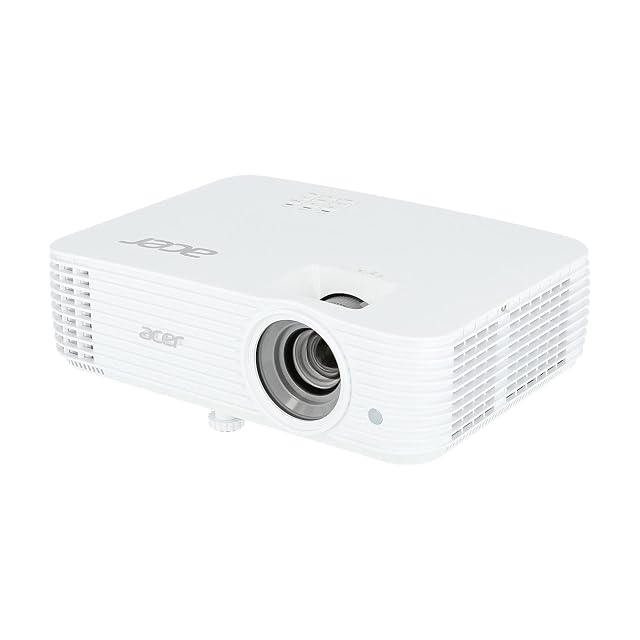
A 4K UHD DLP projector that states its brightness in ANSI lumens at a price where most of the shelf stops doing so — and a specification sheet that reads like a data table rather than a sales page.
Best for: A first 4K projector in a room where the light can be controlled and the machine can sit where the throw ratio wants it.
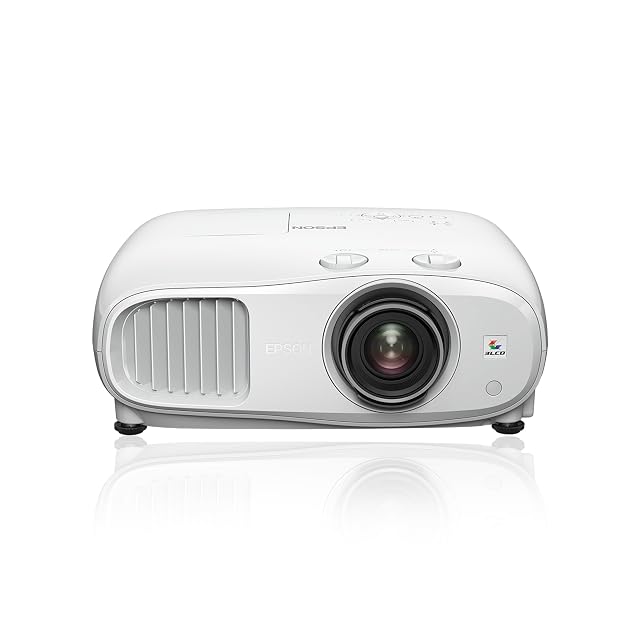
4K PRO-UHD · 3 000 lumens white AND colour brightness · 40 000:1 stated contrast · 3LCD · optional Wi-Fi
A 3LCD projector that publishes white and colour brightness as the same figure — a distinction single-chip machines rarely make, and one that decides how a saturated image actually looks.
Best for: A viewer who notices colour rather than pixel count, and anyone bothered by the rainbow effect single-chip projectors can produce.