The bottom line A small amplifier that tells you what it is built from — which is more useful than a larger unconditioned number, and still not a measurement.
The unusual disclosure
TPA3116. Naming the amplifier chip means the claim can be checked against a datasheet published by someone other than the seller. Almost nothing else in this catalogue offers that, at any price.
What the figure needs to be complete
A load and a supply voltage. Class D output from this chip family varies substantially with both, and “100 W × 2” without them is an upper bound rather than a rating. This page states it as published.
What Class D gives you
Efficiency, which means a small box that runs cool and can sit on a shelf without ventilation. That is why this format exists and why it fits places a conventional integrated amplifier does not.
The tone controls
Bass and treble. Purist amplifiers omit them; real rooms often want them, particularly with small speakers close to a wall. Having them is a practical advantage rather than a compromise.
Where it belongs
A desk system, a bedroom, a second room, or a first pair of passive speakers. It is not a substitute for a full-size integrated amplifier, and it does something that one cannot: fit.
Availability
On sale from 78 € to 80 € on the German, American, British, French, Italian and Spanish Amazon stores at the time of checking.
Prices and availability are what Keepa reported on the date this page was updated; both move.
Prices quoted in this text were read on 4 September 2026. The live price is at the top of the page.
What we like, and what we don't
Strengths
Names the amplifier chipset, which almost no listing does and which makes the design verifiable
Class D runs cool and small, so it fits where a conventional amplifier does not
Bass and treble controls, which a purist amplifier omits and a real room often wants
Compromises
"100 W × 2" has no stated load or distortion, and the chipset's published capability depends heavily on supply voltage
A compact Class D amplifier is a different proposition from a full-size integrated one
No phono stage, no digital inputs stated
Specifications
Channels
2.0 — stated
Topology
Class D — stated
Power
100 W × 2 — stated per channel, without conditions
Chipset
TPA3116 — stated by name
Controls
Bass and treble — stated
Amazon reference
B076P2VS9H (same reference on 6 Amazon marketplaces)
EAN
0713923289420
Questions people actually ask
Why does naming the chipset matter?
Because the chip's own specification is published by its manufacturer, so the claim can be checked against it rather than taken on trust. Very few amplifier listings at any price name the part they are built around.
Is "100 W × 2" realistic?
It depends entirely on the supply voltage and the load, neither of which is stated. The chip family is capable of figures in that region under specific conditions. This page reports the claim as published and notes that the conditions are absent.
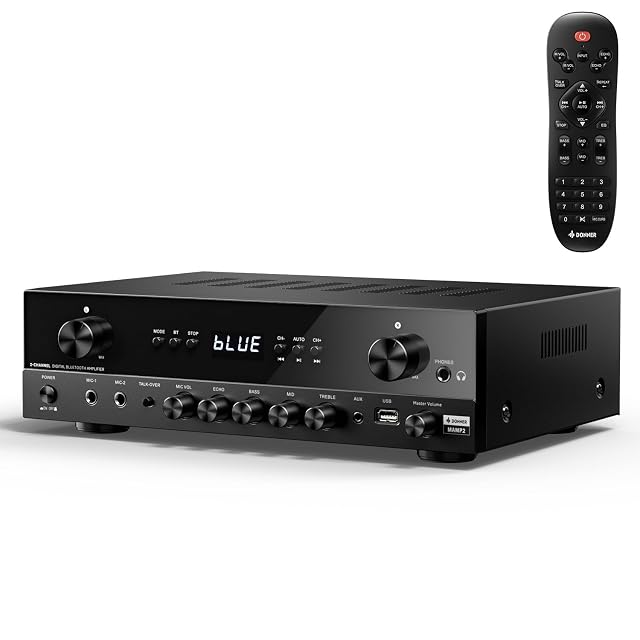
2 channels · 600 W PEAK · Bluetooth 5.3 · phono · optical · coaxial · USB · FM · 2 microphone inputs
A two-channel amplifier with an unusually long input list — including a phono stage — and a power figure stated as peak, which the page reports as such.
Best for: A room with several sources — a turntable, a television, a phone — where connection count matters more than measured power.
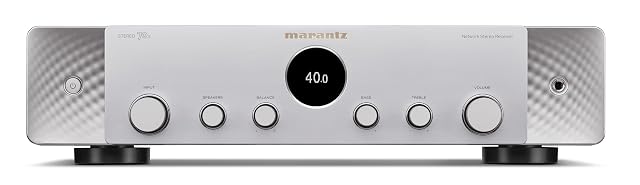
Two channel · HiFi stereo amplifier · Marantz house design
A two-channel amplifier from a house whose recent stereo models carry HDMI — the connection that lets a hi-fi amplifier sit under a television and be controlled by its remote.
Best for: A room where music matters as much as film, and where two very good channels beat seven adequate ones.