The bottom line A properly stated per-channel figure from a maker that publishes conditions elsewhere — the load is the number to chase before buying.
Why “per channel” is the important phrase
A stereo amplifier quoting “140 W” without saying whether that is per channel or in total is telling you very little. 70 W per channel is unambiguous, and it is the form in which the figure can be compared with another amplifier.
The number still missing
The load. 70 W into 8 ohms and 70 W into 4 ohms are different claims: an amplifier whose output nearly doubles as the load halves has a power supply capable of driving difficult speakers, and one that states only the 8-ohm figure generally does not. Denon publishes this in its full specifications; the listing does not.
What it connects to
Bluetooth is stated. HDMI is not, which means a television reaches it by optical or analogue — and that means a second remote for volume, because control does not travel over those connections.
Where the money goes in a two-channel system
Into the speakers, mostly, and into the room. An amplifier of this class driving good speakers in a sensible position will outperform a better amplifier driving poor speakers badly placed.
The setting nobody adjusts
Speaker positioning. Distance from the wall changes bass response more than any component on this page, and it costs nothing to try.
Availability
On sale from 400 € to 480 € on the German, British, Italian and Spanish Amazon stores at the time of checking.
Listed but with no offer on the American Amazon store — the reference exists there and nobody is currently selling it.
Not found on the French Amazon store, where the buy link falls back to a local search rather than to a page that does not exist.
Prices and availability are what Keepa reported on the date this page was updated; both move.
Prices quoted in this text were read on 4 September 2026. The live price is at the top of the page.
What we like, and what we don't
Strengths
Power stated per channel, which is the only form in which a two-channel figure means anything
Bluetooth built in, so a phone reaches it without another box
From a maker whose specification sheets state the load and distortion these figures were measured at
Compromises
The load — 8 or 4 ohms — is not stated in this listing, and it changes what 70 W means
No HDMI stated, so a television connects by optical or analogue rather than by ARC
No phono stage stated in this listing
Specifications
Type
Integrated amplifier — stated
Power
70 W per channel — stated per channel
Wireless
Bluetooth — stated
Load
Not stated in this listing
Amazon reference
B07YCVDKJT (same reference on 5 Amazon marketplaces)
EAN
0747192144364
Questions people actually ask
Is 70 W per channel enough?
For almost any domestic room with speakers of ordinary sensitivity, comfortably. Perceived loudness rises slowly with power — doubling it is about 3 dB — and speaker sensitivity moves the same amount for far less money. What matters more is whether the amplifier is stable into the load your speakers present.
Why does the load matter?
Because 70 W into 8 ohms and 70 W into 4 ohms describe different amplifiers. A design that nearly doubles its output as the load halves has a power supply that can drive difficult speakers; one that states only 8 ohms usually cannot. That figure is not in this listing.
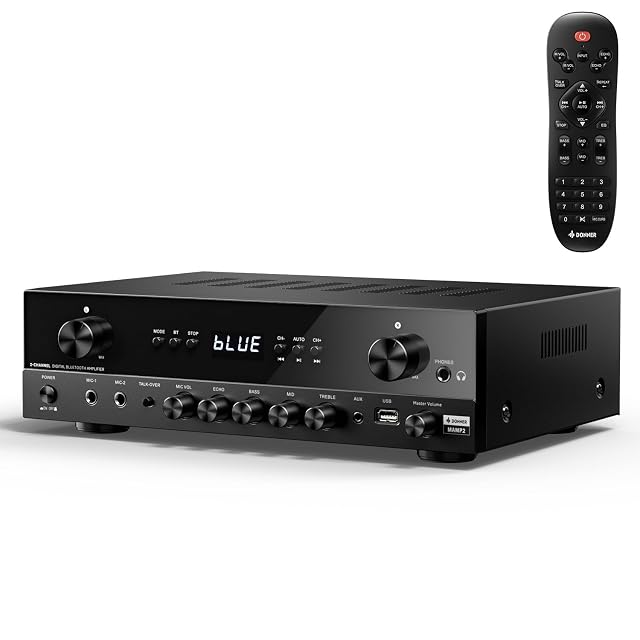
2 channels · 600 W PEAK · Bluetooth 5.3 · phono · optical · coaxial · USB · FM · 2 microphone inputs
A two-channel amplifier with an unusually long input list — including a phono stage — and a power figure stated as peak, which the page reports as such.
Best for: A room with several sources — a turntable, a television, a phone — where connection count matters more than measured power.
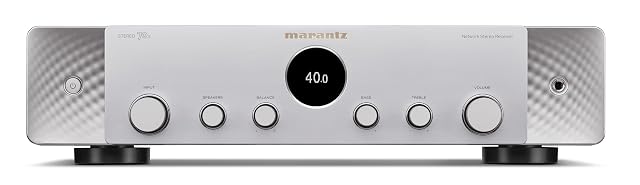
Two channel · HiFi stereo amplifier · Marantz house design
A two-channel amplifier from a house whose recent stereo models carry HDMI — the connection that lets a hi-fi amplifier sit under a television and be controlled by its remote.
Best for: A room where music matters as much as film, and where two very good channels beat seven adequate ones.