A big image from twenty centimetres, and a screen that must match · review
Hisense Laser Cinema PT1 ultra short throw laser projector review
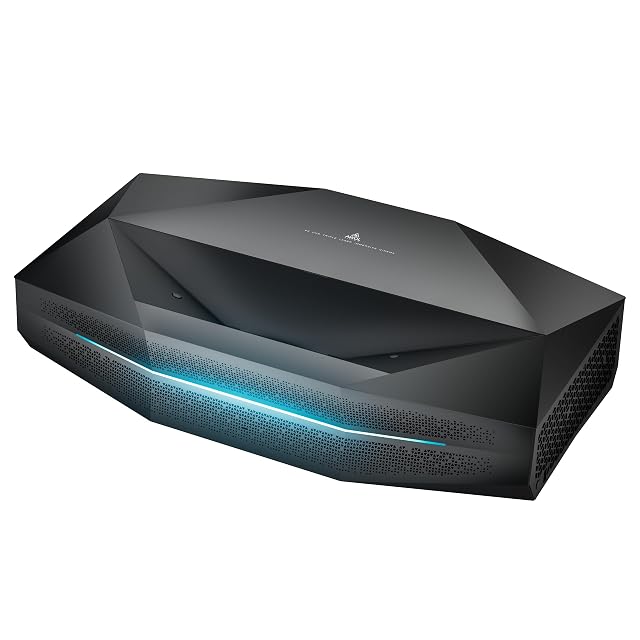
A laser television in the literal sense: an ultra short throw machine that sits under the screen, decodes Dolby Vision and Atmos, and is sold without the screen it needs.
The bottom line The television replacement, honestly described: everything about the format is right, and the purchase is not complete without the screen the maker does not include.
What ultra short throw actually solves
Everything about installation. The machine sits on the furniture directly beneath the image, so there is no ceiling bracket, no cable across the room, and nobody walks through the beam. In a living room that is also a living room, that is the whole argument.
What it demands in return
A rigid, ceiling-light-rejecting screen. At a throw ratio this low, light arrives at a grazing angle: a ripple that is invisible on an ordinary projector becomes a band, and an ordinary white surface returns the room’s light along with the image. The screen is not included here, and it is not an accessory — it is half the product.
The format support
Dolby Vision and HDR10+, plus IMAX Enhanced. Those are separate licences and it is unusual to see both. Dolby Atmos decoding is stated too, which on a machine with built-in audio means the format is decoded rather than that anything reaches your ceiling.
The brightness figure, as published
2 500 lumens. The maker states it in that form, without an ANSI qualifier, and this page reproduces it as published rather than converting it — there is no conversion. What the figure means in your room depends as much on the screen as on the machine.
The specification that is not about films
240 Hz. That is a refresh rate for gaming, and it sits oddly on a machine sold as a cinema. It is genuinely useful with a console and irrelevant to everything else.
Availability
On sale from 1493 € to 1628 € on the German, British, French, Italian and Spanish Amazon stores at the time of checking.
Not found on the American Amazon store, where the buy link falls back to a local search rather than to a page that does not exist.
Prices and availability are what Keepa reported on the date this page was updated; both move.
Prices quoted in this text were read on 4 September 2026. The live price is at the top of the page.
What we like, and what we don't
Strengths
Sits on the furniture beneath the image: no ceiling bracket, no cable run, no shadows
Dolby Vision and HDR10+ together, which is unusual — the two are separately licensed
A 240 Hz stated refresh rate, which is a gaming specification rather than a film one
A laser source with no lamp to replace
Compromises
The brightness figure is stated as "lumens" without an ANSI qualifier, and this page does not convert it
The screen is not included and is not optional: an ultra short throw machine on an ordinary surface looks worse than a cheaper projector on a good one
Alignment is unforgiving at this throw ratio — a centimetre of rotation is a visible distortion
Specifications
Throw
Ultra short throw — stated
Light source
Laser, LPU technology — stated
Resolution and HDR
4K, Dolby Vision, HDR10+, IMAX Enhanced — stated
Brightness
2 500 lumens — stated by the maker in this form, not qualified as ANSI
Image size
80 to 150 inches — stated
Refresh rate
240 Hz — stated
Audio
Dolby Atmos decoding — stated
Screen
Not included — stated by the maker
Amazon reference
B0FBW9Q8HZ (same reference on 5 Amazon marketplaces)
EAN
6942351423012
Questions people actually ask
Why does the screen matter so much here?
Because the light arrives almost parallel to the surface. That exaggerates every ripple — a gentle wave in a pull-down screen becomes a visible band — and an ordinary white screen reflects the room's ceiling light straight back at you. These machines are paired with rigid, ceiling-light-rejecting screens for both reasons.
Is 2 500 lumens enough for daylight?
Paired with a CLR screen, this class of machine is what daylight viewing is sold on, and the figure is not stated in ANSI so it cannot be placed on the same scale as machines that do. What is certain is that the screen contributes as much as the projector in a bright room.
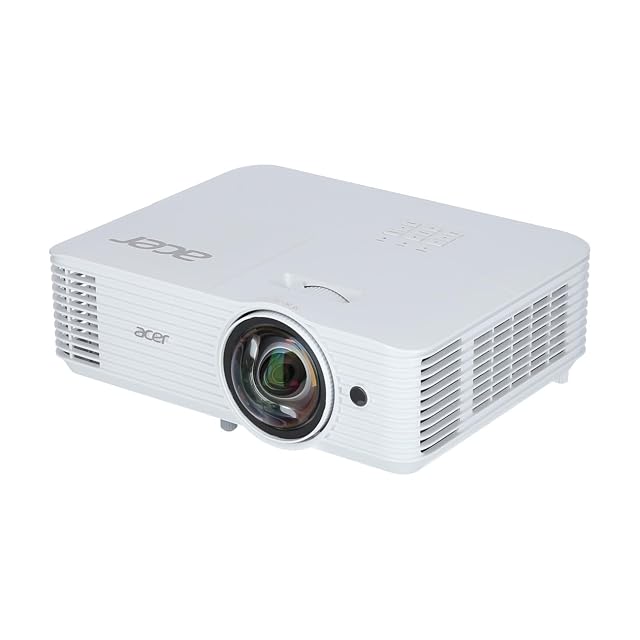
Short throw · Full HD 1 920 × 1 080 · 3 500 ANSI lumens · 10 000:1 stated contrast · 3D Ready · keystone
A short-throw 1080p projector at the accessible end of a family that is usually expensive — it sits close to the screen without needing the rigid, matched surface an ultra short throw machine demands.
Best for: A small room where a projector at the back is impossible, and where a rigid ALR screen is not in the budget.
Ultra short throw · 4K · 2 600 ISO lumens · 6 000:1 NATIVE contrast · Dolby Vision · 1 ms input lag · up to 200 inches
The only machine in this catalogue that publishes a native contrast ratio — 6 000:1 — alongside a measured brightness figure, which is what makes it comparable rather than merely impressive.
Best for: Someone who reads specifications and wants an ultra short throw machine whose figures can be checked against another that publishes the same ones.
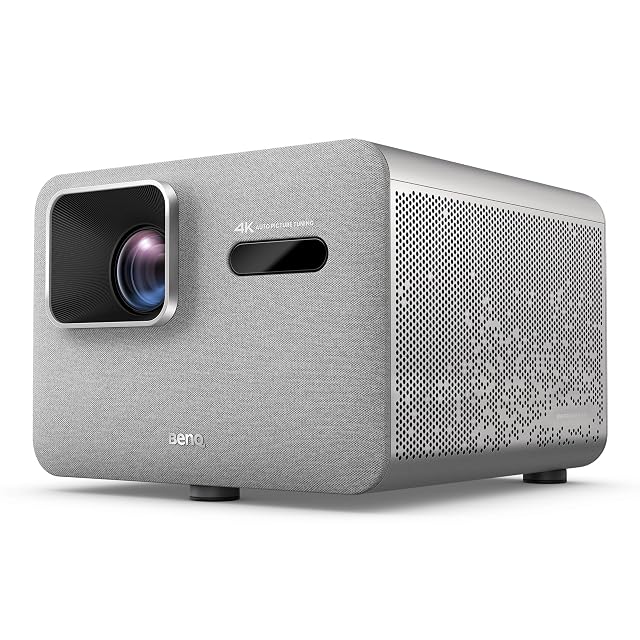
Short throw · 4K HDR · 3 000 ANSI lumens · Google TV built in
The 4K version of the short-throw idea, with Google TV on board — a self-contained machine that sits close to the wall and needs nothing else plugged into it.
Best for: A room too small for a long throw projector where the picture still has to be 4K, and where one object is preferable to three.