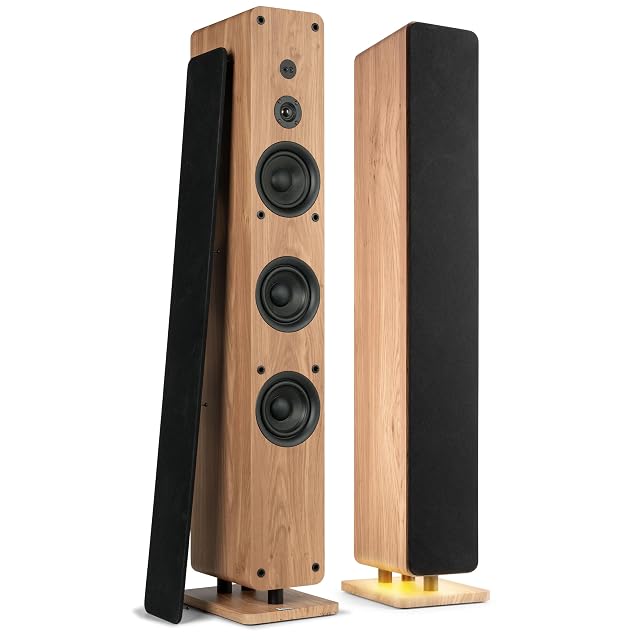
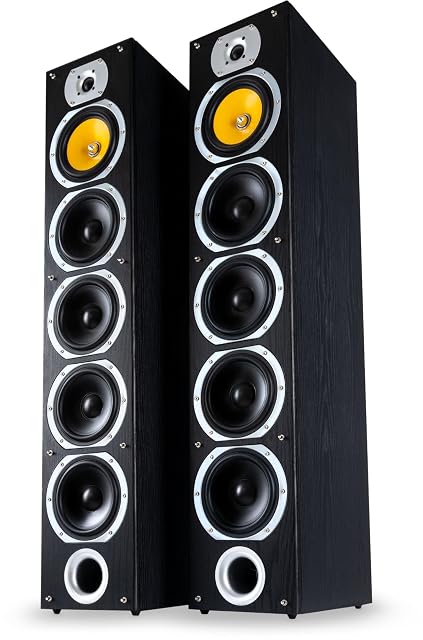
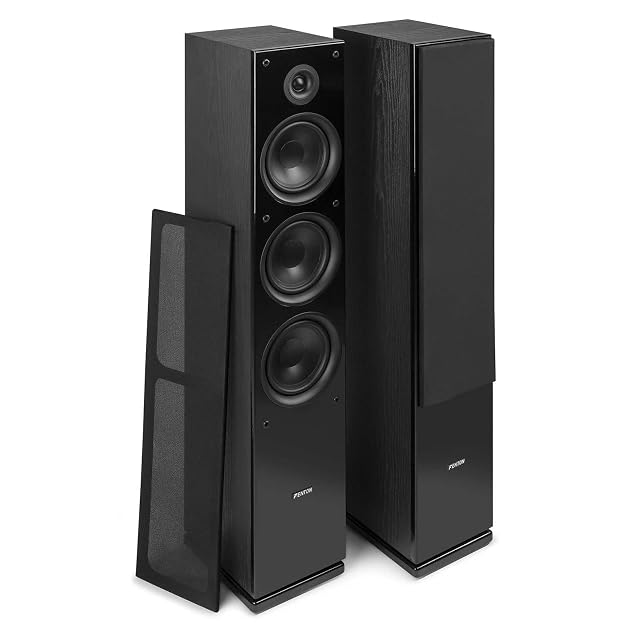
The bottom line The complete answer in two boxes: three ways, two woofers, a Kevlar midrange and the amplifier already matched to them.
What “active” means here
The amplification is inside the cabinets and is matched to the drivers. The crossover is applied to the signal before amplification rather than after, which means each driver gets its own amplifier channel and its own filter. That is a design the manufacturer controls completely, and it is why active speakers can be voiced more precisely than a passive pair on a general-purpose amplifier.
The driver arrangement
Three ways: two woofers, a Kevlar midrange with a phase plug, and a 25 mm tweeter. The midrange matters most — it is the band voices occupy, and giving it a dedicated driver is what separates this from a two-way design asking its woofer to do both jobs.
What you give up
Separability. A passive system ages in parts and is replaced in parts; an active speaker is one product. That is a real consideration on something meant to last a decade, and it is the honest cost of the convenience.
Why sensitivity is not quoted
Because it is meaningless on an active speaker. Sensitivity describes how loud a passive speaker plays for a given amplifier power, and here the amplifier is not a variable.
What still applies
Placement. Distance from the wall changes bass response more than any specification on this page, and it costs nothing to experiment.
Availability
On sale from 730 € to 740 € on the German and French Amazon stores at the time of checking.
Listed but with no offer on the Italian and Spanish Amazon stores — the reference exists there and nobody is currently selling it.
Not found on the American and British Amazon stores, where the buy link falls back to a local search rather than to a page that does not exist.
Prices and availability are what Keepa reported on the date this page was updated; both move.
Prices quoted in this text were read on 4 September 2026. The live price is at the top of the page.
What we like, and what we don't
Strengths
Three-way with a dedicated Kevlar midrange, which is where voices sit and where a two-way design compromises
Active: no amplifier to buy, match or house, and the crossover is engineered for these exact drivers
Two woofers per cabinet, which moves air with less excursion each
Compromises
An active speaker cannot have its amplifier upgraded — the two are one product for life
No sensitivity or frequency response published, as sensitivity is meaningless on an active design
The most expensive speaker pair in this catalogue
Specifications
Type
Active pair — amplification built in, no external amplifier needed
Configuration
Three-way — stated
Bass
Two high-load woofers — stated
Midrange
Kevlar cone with phase plug — stated
Tweeter
25 mm — stated
Amazon reference
B0GWJJSRJ9 (same reference on 4 Amazon marketplaces)
EAN
4048945589859
Questions people actually ask
What does active actually change?
The amplifier sits inside the cabinet and is matched to those specific drivers, with the crossover applied before amplification rather than after. That is engineering the maker controls end to end, and it removes both a purchase and a compatibility question.
What do I lose?
The ability to change the amplifier. In a passive system the electronics and the speakers age separately and can be replaced separately; in an active one they are a single product. If the amplifier fails in year eight, the speaker is the repair.
Passive pair · 500 W maximum stated · works with common hi-fi amplifiers
The entry floorstander: a passive pair with a maximum power figure and little else published, at the price where most people buy their first tower speakers.
Best for: A first pair of tower speakers, where the alternative is bookshelf speakers on a shelf.