Seventy per cent of a film comes out of this one · review
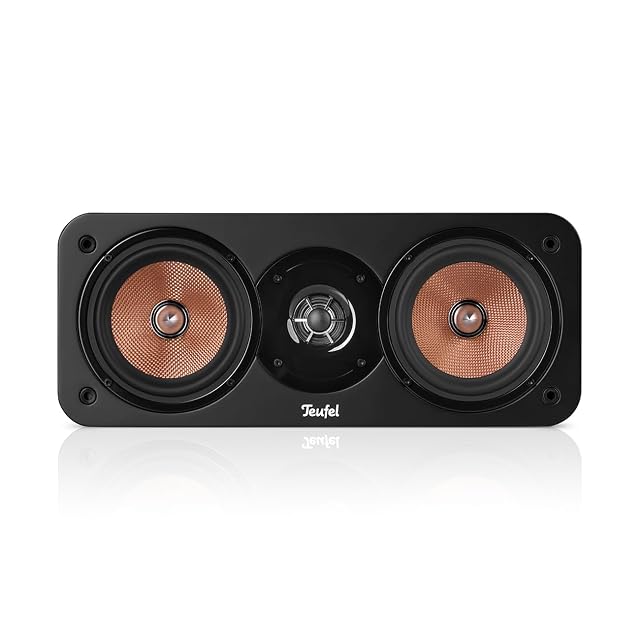
Canton GLE 455.2 centre speaker, 80/140 W review
The only speaker in this catalogue with a complete published specification — sensitivity, frequency range, crossover points and driver diameters, all stated.
The bottom line The specification sheet this entire catalogue needs more of — and a three-way centre, which is what a dialogue channel deserves.
Why this page is different from the others on this shelf
Because there is something to write. Canton publishes sensitivity, frequency range, both crossover points and the driver diameters. Every other speaker in this catalogue publishes some of that at best, and most publish a power figure and a photograph.
What the numbers say
Two crossover points — 400 Hz and 3 000 Hz — mean three ways: a woofer, a dedicated midrange and a tweeter. In a centre speaker that matters more than anywhere else, because dialogue sits in the midrange and a two-way design asks its woofer to reproduce it while also moving air.
30 Hz to 30 000 Hz, without a tolerance. That is the one figure here that would benefit from a ±3 dB qualifier, and it is not given.
The power pair
80 W nominal, 140 W music. The German hi-fi convention, and more informative than a single number: the first is what it takes continuously, the second what it survives in peaks.
The practical constraint
A three-way centre is a deep cabinet. Measure the space under the television before ordering — including whether it will block the infrared window.
Matching
Sold singly, from a range that includes floorstanders and surrounds. A system built inside it will match; a centre bought alone into a mixed system will not, and that is audible when a voice moves across the screen.
Availability
On sale at around 217 € on the German Amazon store at the time of checking.
Listed but with no offer on the British, French, Italian and Spanish Amazon stores — the reference exists there and nobody is currently selling it.
Not found on the American Amazon store, where the buy link falls back to a local search rather than to a page that does not exist.
Prices and availability are what Keepa reported on the date this page was updated; both move.
Prices quoted in this text were read on 4 September 2026. The live price is at the top of the page.
What we like, and what we don't
Strengths
A complete specification: sensitivity, frequency range, crossover frequencies and driver diameters, all published
Two crossover points means three-way — a dedicated midrange, which is where voices live
Aluminium woofer with a wave surround, described rather than asserted
Power quoted as a nominal/music pair in the German convention rather than as one large number
Compromises
The frequency range is given without a tolerance, which would make it fully rigorous
A three-way centre is a large cabinet — check it fits under the television
Sold singly, so a matching front pair is a separate purchase
Specifications
Power handling
80 W nominal / 140 W music — stated as a pair
Sensitivity
Stated at 1 W / 1 m in the maker's specification
Frequency range
30 Hz to 30 000 Hz — stated
Crossover points
400 Hz and 3 000 Hz — stated
Woofer
1 × 160 mm aluminium with wave surround — stated
Configuration
Three-way — implied by two crossover points
Amazon reference
B0045FD6V6 (same reference on 5 Amazon marketplaces)
EAN
4010243028583
Questions people actually ask
Why do the crossover frequencies matter?
They tell you the design. Two crossover points — 400 Hz and 3 000 Hz — mean three drivers each covering a band, with a dedicated midrange. In a centre speaker that is exactly where dialogue sits, and handing it to its own driver rather than to a woofer is the point.
Should the centre match my front speakers?
Ideally yes, and from the same range. Matching drivers and crossovers mean a voice moving across the screen stays the same voice. Where matching is impossible, a well-specified centre is better than a mismatched one from the right brand.
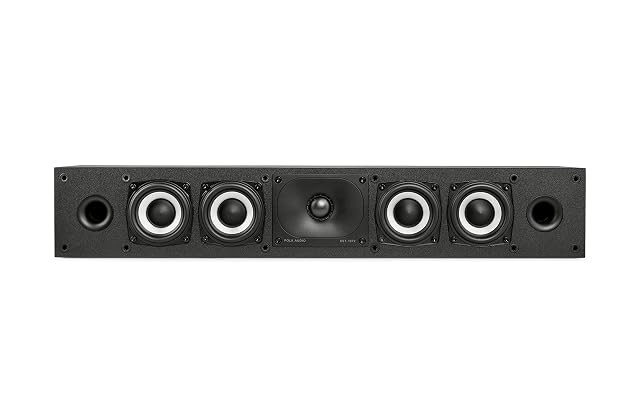
Centre channel · Hi-Res certified · four 3-inch woofers with Dynamic Balance · Terylene tweeter
A four-woofer centre from a range that also makes matching floorstanders, surrounds and height modules — which is what makes a system out of a speaker.
Best for: The centre of a Polk system, where the front three come from one range and behave as one.