Passive, and meant for a stand rather than a desk · review
Magnat Monitor S10 B two-way bookshelf pair review
The only bookshelf speaker in this catalogue that publishes RMS power, impedance range AND sensitivity — the three figures that decide whether an amplifier suits it.
The bottom line The best-specified bookshelf speaker here by a distance: three figures published where the rest of the shelf publishes none.
Why this page can say more than its neighbours
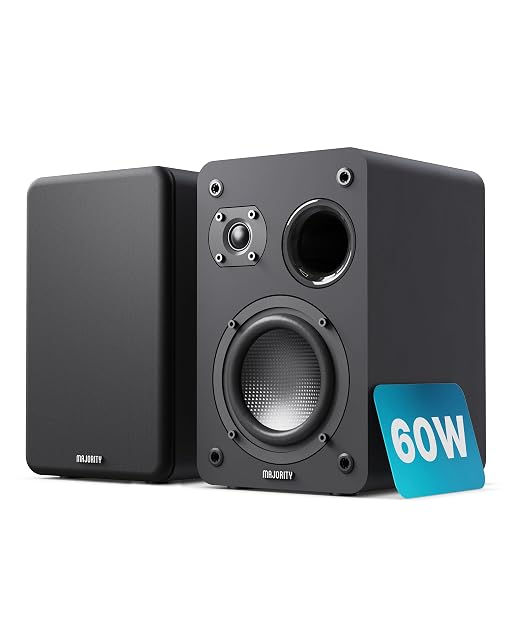
Because Magnat publishes the numbers. 60 W RMS with a 120 W peak, 4 to 8 Ω, 88 dB sensitivity, a 110 mm woofer-midrange and a 13 mm tweeter. That is the complete amplifier-matching set, and no other bookshelf speaker in this catalogue offers it.
What each figure decides
Sensitivity says how loud it plays for a given amplifier. Impedance says how hard it is to drive, and a stated range rather than a single nominal value is the more honest form. RMS with a peak alongside separates what it sustains from what it survives.
What the driver arrangement tells you
A 110 mm woofer-midrange means one driver covers the bass and the range where voices sit. That is a two-way design and it is what almost every compact speaker is. The coated paper cone is a material fact, stated rather than praised.
What is missing
Frequency response with a tolerance. It would say how low the cabinet reaches, and it is not published.
In use
Set the receiver to “small” for these and cross over to a subwoofer. A 110 mm driver in a compact cabinet produces little below a couple of hundred hertz, and asking it for more is what makes a small speaker sound strained.
Availability
On sale from 135 € to 179 € on the German, French, Italian and Spanish Amazon stores at the time of checking.
Listed but with no offer on the British Amazon store — the reference exists there and nobody is currently selling it.
Not found on the American Amazon store, where the buy link falls back to a local search rather than to a page that does not exist.
Prices and availability are what Keepa reported on the date this page was updated; both move.
Prices quoted in this text were read on 4 September 2026. The live price is at the top of the page.
What we like, and what we don't
Strengths
Publishes RMS power, impedance range and sensitivity together — the complete amplifier-matching set
88 dB sensitivity is a real figure that can be compared with any other speaker publishing one
Driver sizes and cone material stated rather than described
Compromises
A 4 to 8 Ω range means the impedance dips, and a receiver rated for 6 Ω minimum should be checked
No frequency response with tolerance published
A 110 mm woofer in a compact cabinet needs a subwoofer for full-range use
Specifications
Configuration
Two-way — stated
Power
60 W RMS, 120 W peak — stated as both
Impedance
4 to 8 Ω — stated as a range
Sensitivity
88 dB — stated
Woofer-midrange
110 mm FE-Dynamics, coated paper cone — stated
Tweeter
13 mm — stated
Amazon reference
B0BC953QQD (same reference on 5 Amazon marketplaces)
EAN
4018843144801
Questions people actually ask
What does "4 to 8 Ω" mean for my amplifier?
That the impedance varies with frequency and dips toward 4 Ω somewhere. An amplifier rated for 4 Ω loads will be comfortable; one rated only for 8 Ω may run hot at volume. It is the honest way to state impedance and it asks a question of the amplifier.
Is 88 dB sensitivity good?
It is ordinary and useful because it is published. A speaker at 88 dB plays as loud on one watt as a 91 dB speaker does on half of one — the comparison only works because both numbers exist, and most of this shelf publishes neither.