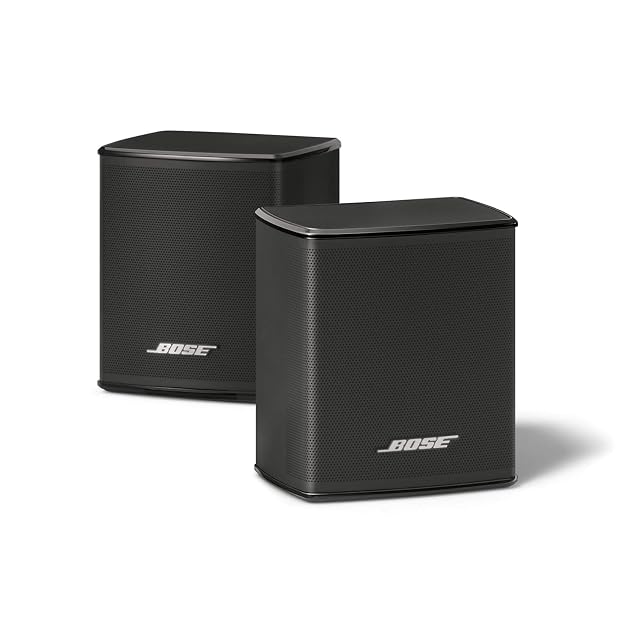
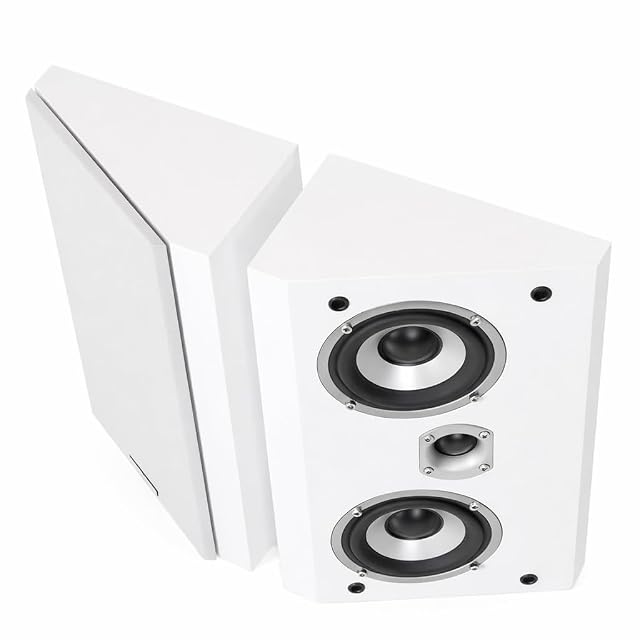
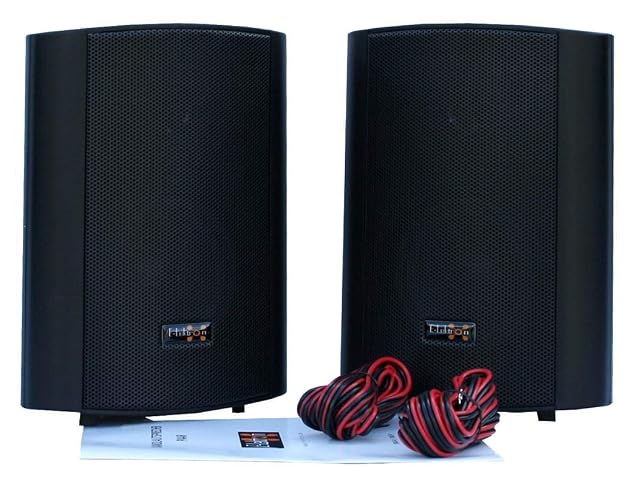
The bottom line The smallest real surround speaker here — coherent in the midrange, dependent on a subwoofer, and honest about being a satellite.
What a satellite speaker is
A speaker designed to reproduce everything above a crossover point and nothing below it, on the understanding that a subwoofer handles the rest. These are that, explicitly, and the design only works as part of that arrangement.
The full-range driver
One driver, no crossover. The advantage is coherence through the midrange, where a crossover in a two-way design sits. The limit is at both extremes — deep bass and the top octave — and in a rear channel that matters much less than it would at the front.
What you must set in the receiver
The surround channels to “small”, and the crossover high enough that the subwoofer takes over where these stop. Left at “large”, the receiver asks them for bass they cannot produce and the result is thin and distorted.
The size argument
This is the smallest cabinet in the catalogue. For a rear speaker on a wall in a living room, size is frequently the deciding factor — and a speaker that gets installed beats a better one that does not.
What is not published
Sensitivity, impedance, frequency response. As with almost every speaker here except the Canton.
Availability
On sale from 45 € to 55 € on the German, French, Italian and Spanish Amazon stores at the time of checking.
Listed but with no offer on the British Amazon store — the reference exists there and nobody is currently selling it.
Not found on the American Amazon store, where the buy link falls back to a local search rather than to a page that does not exist.
Prices and availability are what Keepa reported on the date this page was updated; both move.
Prices quoted in this text were read on 4 September 2026. The live price is at the top of the page.
What we like, and what we don't
Strengths
A single full-range driver has no crossover, so there is nothing to blur the midrange
The smallest cabinet in this catalogue, which is often the deciding factor for a rear speaker
Passive, so any receiver drives it
Compromises
A full-range driver in a tiny cabinet cannot produce low frequencies — this needs a subwoofer, not optionally
No sensitivity, impedance or frequency response published
Sold for surround and office use, which are different jobs
Specifications
Type
Passive satellite pair — stated
Driver
Full-range, covering the whole band — stated
Cabinet
Ultra compact — stated
Mounting
Wall mounting — stated
Use
Surround in a 5.1 system, or office — stated
Amazon reference
B0012AWF14 (same reference on 5 Amazon marketplaces)
EAN
4250019104077
Questions people actually ask
What is a full-range driver?
One driver covering the whole audible band rather than splitting it between a woofer and a tweeter. Its advantage is no crossover in the midrange, which is where the ear is most sensitive. Its limit is the extremes: a small full-range driver produces neither deep bass nor the top octave.
Do I need a subwoofer with these?
Yes, and not as a refinement. A cabinet this small produces almost nothing below a few hundred hertz, so the receiver has to be set to "small" for these channels and everything below the crossover handed to a subwoofer. Without one, the rear channels will simply be thin.
Passive pair · 28.8° angled baffle stated · wall or ceiling mount · Dolby Atmos compatible
A passive surround pair with an angled baffle — 28.8 degrees, stated — which is the specification that decides where the sound goes once the speaker is on a wall.
Best for: A receiver-based system where the rear speakers have to go on a wall and be driven properly.