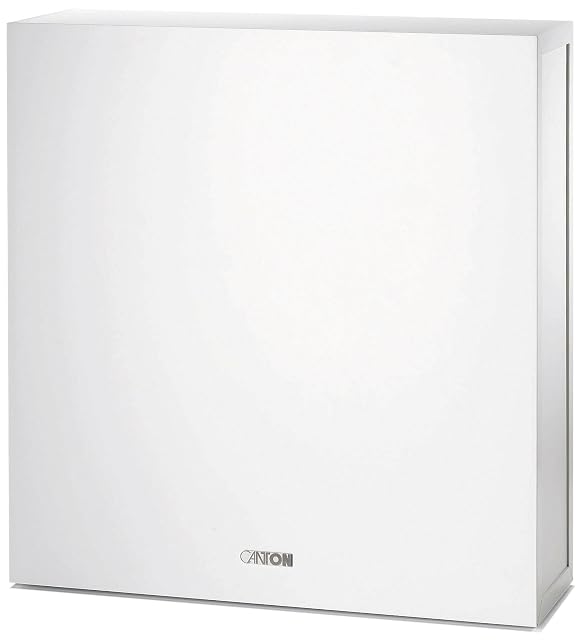
The bottom line The subwoofer that publishes what matters: an extension figure, a cabinet material and a filter — modest in size, and the only one here that can be compared on the right number.
The number nobody else gives
Down to 35 Hz. It is the figure that says how low a subwoofer reaches, and it is absent from every other subwoofer listing in this catalogue. What would make it fully rigorous is a tolerance — “35 Hz (−6 dB)” — and that is not stated. As published, it is still more than anything else here offers.
The cabinet, stated
MDF, described as reducing resonance. A subwoofer cabinet that vibrates adds its own sound to the music, and material is one of the two things that stop it. It is a modest specification and it is a specification.
The low-pass filter
On board, which means the subwoofer can be integrated even with an amplifier that offers no crossover control. On a two-channel system, that is the difference between a subwoofer that blends and one that booms.
What it will not do
Fill a large room. An 8-inch driver on 70 W is a small-to-medium-room proposition, and the honest comparison is against the 12-inch cabinet elsewhere in this catalogue rather than alongside it.
The standby detail
Automatic. A subwoofer is left powered permanently, and a component that sleeps when nothing is playing is one less thing consuming electricity for years.
Availability
On sale at around 129 € on the German, French, Italian and Spanish Amazon stores at the time of checking.
Listed but with no offer on the American and British Amazon stores — the reference exists there and nobody is currently selling it.
Prices and availability are what Keepa reported on the date this page was updated; both move.
Prices quoted in this text were read on 4 September 2026. The live price is at the top of the page.
What we like, and what we don't
Strengths
Publishes a frequency extension figure — 35 Hz — which no other subwoofer in this catalogue does
An MDF cabinet stated explicitly, which is what stops the box adding its own resonance
A low-pass filter on board, so it can be integrated with speakers that have no crossover control
Automatic standby, which matters on a component that is powered permanently
Compromises
The extension figure has no stated tolerance — "down to 35 Hz" without a −3 or −6 dB reference
70 W and an 8-inch driver put it below the larger cabinets here in output
RCA input only, no LFE input stated
Specifications
Driver
8 inch (20.3 cm) — stated
Power
70 W — stated
Frequency extension
Down to 35 Hz — stated, and the only extension figure in this catalogue
Filter
Low-pass filter — stated
Cabinet
MDF, for reduced resonance — stated
Connections
RCA — stated
Standby
Automatic standby — stated
Amazon reference
B0F6NH4373 (same reference on 6 Amazon marketplaces)
EAN
6923520216918
Questions people actually ask
Why does the extension figure matter so much?
Because it is the specification that actually says how low a subwoofer goes, and almost nobody publishes it. Driver size and power are proxies; extension is the answer. Here it is stated as 35 Hz, though without the tolerance that would make it fully rigorous.
What is a low-pass filter for?
It sets the frequency above which the subwoofer stops playing, so it does not overlap with the main speakers. If the amplifier or receiver has no crossover control, the filter on the subwoofer is what makes integration possible at all.