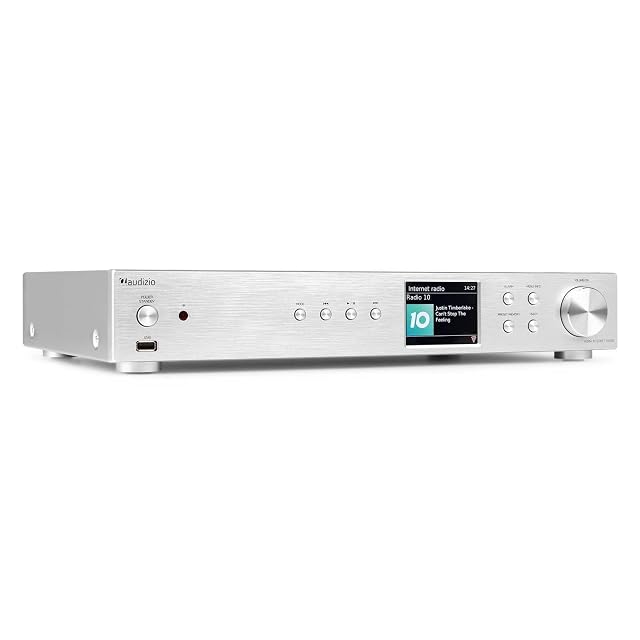
Cambridge Audio EVO 150 SE all-in-one amplifier and network player review
An amplifier and a network player in one chassis, with 150 W per channel stated — the only product in this catalogue that is both a serious amplifier and a serious streamer.
The bottom line The one product here that replaces a receiver, a streamer and a DAC at once — and states its power per channel, which almost nothing else in this catalogue does.
What it replaces
A stereo amplifier, a network streamer, a DAC and a Bluetooth receiver. In a living room where the system is a pair of speakers and a television, that is four boxes reduced to one.
The figure stated properly
150 W per channel. Per channel, not summed — which is the only form in which a two-channel figure means anything. What the listing does not give is the load: 150 W into 8 ohms and into 4 describe different amplifiers, and the full specification sheet carries it.
The connection that matters most in this room
HDMI ARC. It is what allows a television remote to control this amplifier, and it is the difference between a hi-fi system that gets used with the television and one that sits beside it.
The streaming side
AirPlay 2 and Chromecast built in, plus aptX HD over Bluetooth. Between them, almost any phone in a household can send audio to it without an app being installed. That breadth is a licensing achievement rather than a technical one, and it is unusual.
What to think about before buying
Whether one box is right for a decade. The amplifier will age slowly; the streaming platform will age at the pace of the services it talks to. In an all-in-one those two are welded together.
Availability
On sale from 2290 € to 2399 € on the German, British, French, Italian and Spanish Amazon stores at the time of checking.
Not found on the American Amazon store, where the buy link falls back to a local search rather than to a page that does not exist.
Prices and availability are what Keepa reported on the date this page was updated; both move.
Prices quoted in this text were read on 4 September 2026. The live price is at the top of the page.
What we like, and what we don't
Strengths
HDMI ARC, so a television remote controls the volume — the feature that makes a hi-fi amplifier work under a screen
150 W per channel stated per channel rather than as a total
AirPlay 2 and Chromecast both built in, which covers almost every phone in a household
aptX HD rather than plain Bluetooth, which carries more than SBC does
Compromises
The load the 150 W figure was measured into is not stated in this listing
By far the most expensive component in this catalogue
An all-in-one cannot have its amplifier and its streamer upgraded separately
Specifications
Power
150 W per channel — stated per channel
Type
All-in-one amplifier and network player — stated
Streaming
AirPlay 2, Chromecast built in, high-resolution streaming — stated
Wireless
Bluetooth aptX HD — stated
Television
HDMI ARC — stated
Amazon reference
B0FBS82ZG3 (same reference on 5 Amazon marketplaces)
EAN
5055300423948
Questions people actually ask
Why does HDMI ARC matter on a hi-fi amplifier?
Because it is what lets a television remote control the amplifier's volume, and what makes both power on together. Without it, a hi-fi amplifier under a television means a second remote for the rest of its life — which is why recent two-channel designs have started including it.
Is an all-in-one a compromise?
It is a trade. One box means fewer cables, one remote and a coherent design; it also means the streaming section — the part that ages fastest — cannot be replaced without replacing the amplifier. For a system meant to last a decade, that is the question to weigh.
Wi-Fi and Bluetooth · AirPlay · DLNA · UPnP · internet radio · NAS playback · optical and 3.5 mm outputs
A multiroom receiver with an unusually long protocol list — AirPlay, DLNA, UPnP and NAS playback — which is what lets it fit into a network that already exists.
Best for: A household with music on a network drive, where the streaming should not depend on a subscription service.