Yamaha RX-V6A 7.2 channel network AV receiver review
A 7.2 network receiver with a height virtualiser — processing that produces height without ceiling speakers, and which the maker names rather than implies.
The bottom line A well-equipped 7.2 receiver that names its height processing honestly — the right choice where nothing can go on the ceiling.
The naming that matters
Height Virtualizer. The maker states that the height effect is produced by processing rather than by drivers aimed at the ceiling. That is the distinction this entire catalogue turns on, and it is refreshing to see it in a product name rather than hidden in a manual.
What virtualisation does and does not do
It takes the height information in an Atmos or DTS:X mix and renders it psychoacoustically across the speakers you have. The result is a taller, more enveloping soundstage. What it cannot do is place a helicopter at a specific point above your head, which is what physical height channels are for.
The network side
It is a streaming source as well as an amplifier, which removes a box. What runs on it is a licensing question, as always, and worth checking against the services you use.
The gaming functions
Relevant if a console is in the system, irrelevant otherwise. Variable refresh rate and low latency modes pass through the HDMI board, and the board is what dates a receiver.
Room correction
Yamaha’s own system, and one of the two mature ones here. Run it properly and check what it entered afterwards — particularly the speaker sizes and distances, which are the settings an untuned system gets most wrong.
Availability
On sale from 589 € to 690 € on the German, French, Italian and Spanish Amazon stores at the time of checking.
Listed but with no offer on the British Amazon store — the reference exists there and nobody is currently selling it.
Not found on the American Amazon store, where the buy link falls back to a local search rather than to a page that does not exist.
Prices and availability are what Keepa reported on the date this page was updated; both move.
Prices quoted in this text were read on 4 September 2026. The live price is at the top of the page.
What we like, and what we don't
Strengths
Names its height processing as a virtualiser rather than implying physical height channels
Network functions on board, so it is a streaming source as well as an amplifier
Gaming-specific functions stated, which matters if a console is in the system
Yamaha's room correction, which is one of the two mature systems in this catalogue
Compromises
Height virtualisation is not the same as height speakers, and the difference is audible
The HDMI board is what dates a receiver, and its detail is not in this listing
Voice control adds a dependency on a service that may change
Specifications
Channels
7.2 — stated
Height
Dolby Atmos Height Virtualizer — stated as virtualisation
Gaming
Gaming-specific functions — stated
Voice control
Compatible with voice control systems — stated
Network
Network receiver — stated
Amazon reference
B08G4X4TLW (same reference on 5 Amazon marketplaces)
EAN
4957812660471
Questions people actually ask
Is a height virtualiser worth having?
In a room where up-firing or ceiling speakers are impossible, yes — it is a real effect produced by processing, and it is better than discarding the height information entirely. It cannot place a specific sound above you, and the maker naming it as virtualisation rather than as Atmos speakers is the honest framing.
What are "gaming-specific functions"?
Generally variable refresh rate and auto low latency mode passed through the HDMI board, plus low-latency processing modes. They matter for a console and not at all for films, and the specific list is worth checking in the full specification.
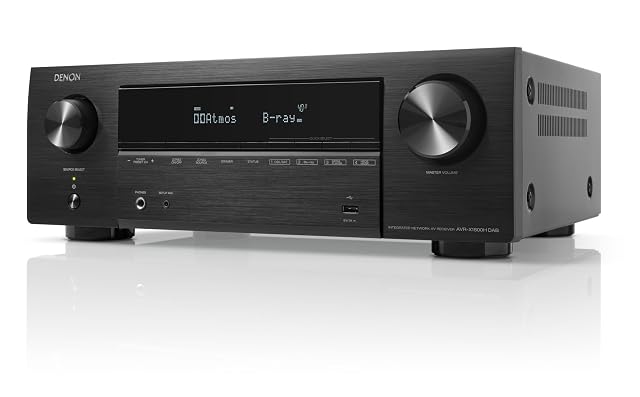
A 7.2 receiver from the house that states power with its conditions — the specification style that makes a receiver comparable to anything else that does the same.
Best for: A first proper surround system, with enough channels to add height speakers later without replacing the receiver.
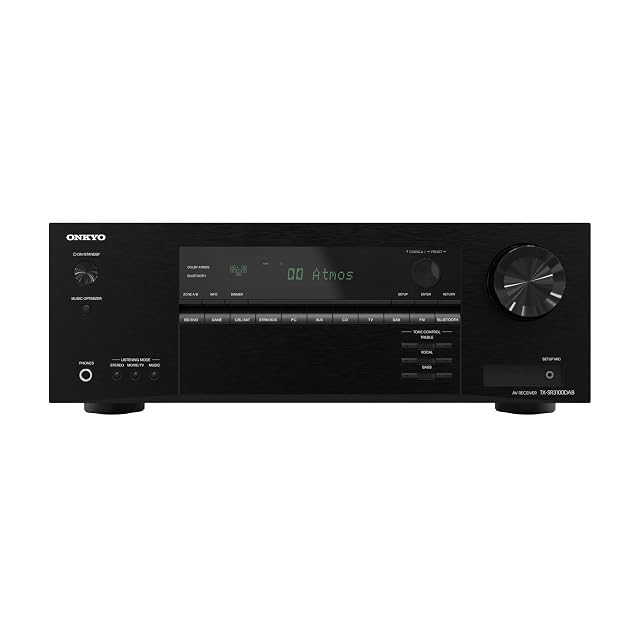
A 5.2 receiver with an 8K-capable HDMI board — the board is what dates a receiver, and this one is specified for a resolution beyond what most systems will use.
Best for: A first 5.1 system where the budget matters and the HDMI board should not be the reason to replace it in three years.
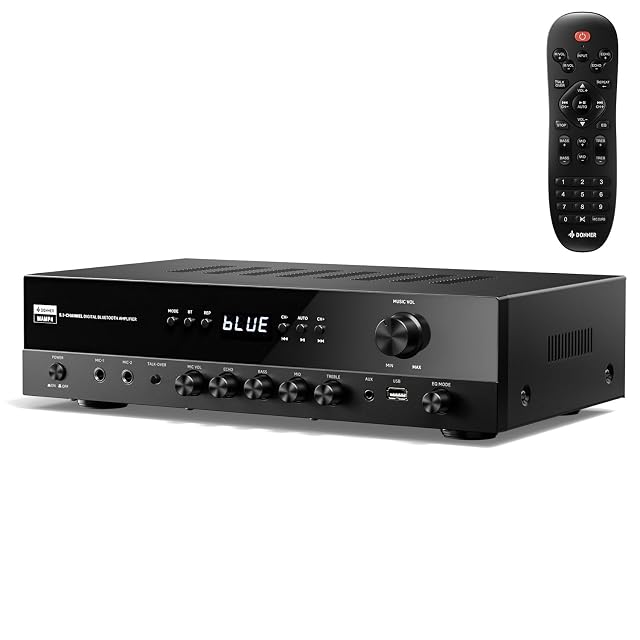
5.1 channels · Bluetooth 5.3 · optical and coaxial in · USB · FM · 2 microphone inputs · echo · RCA
A 5.1 amplifier with two microphone inputs and echo — which places it between a home cinema receiver and a karaoke amplifier, and the page says which parts serve which.
Best for: A room that wants five speakers driven cheaply from an optical output, and where karaoke is a real use rather than a joke.